The Javanese Language, Literature, and Culture Program demonstrated its role in the preservation and development of the archipelago's manuscript heritage through its participation in a series of activities organized by the Nusantara Manuscript Society (Manassa) 2025. This prestigious event included the 20th Nusantara Manuscript International Symposium, the 2025 National Collective Memory Manuscript Award (IKON), and the 8th National Conference of the Nusantara Manuscript Society, which will take place on October 15-17, 2025, at the Auditorium of the National Library of the Republic of Indonesia and the National Research and Innovation Agency (BRIN) Building in Jakarta. This event, attended by researchers, academics, and manuscript enthusiasts from various regions in Indonesia, is an important forum for strengthening collaboration in the preservation, research, and utilization of ancient Nusantara manuscripts as the nation's cultural heritage.
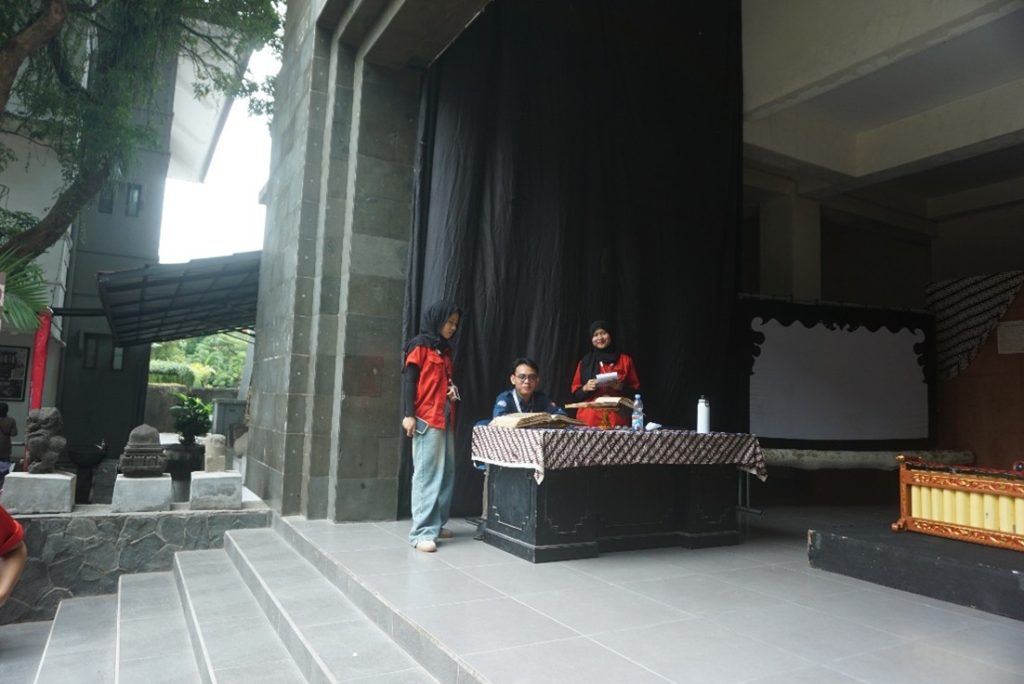
On this occasion, Dr. Arsanti Wulandari, M.Hum., a lecturer in the Javanese Language, Literature, and Culture Study Program, together with Nanda Nursa Alya, S.S., an alumnus from the same study program, actively participated not only as participants but also as speakers at the XX International Symposium on Nusantara Manuscripts.
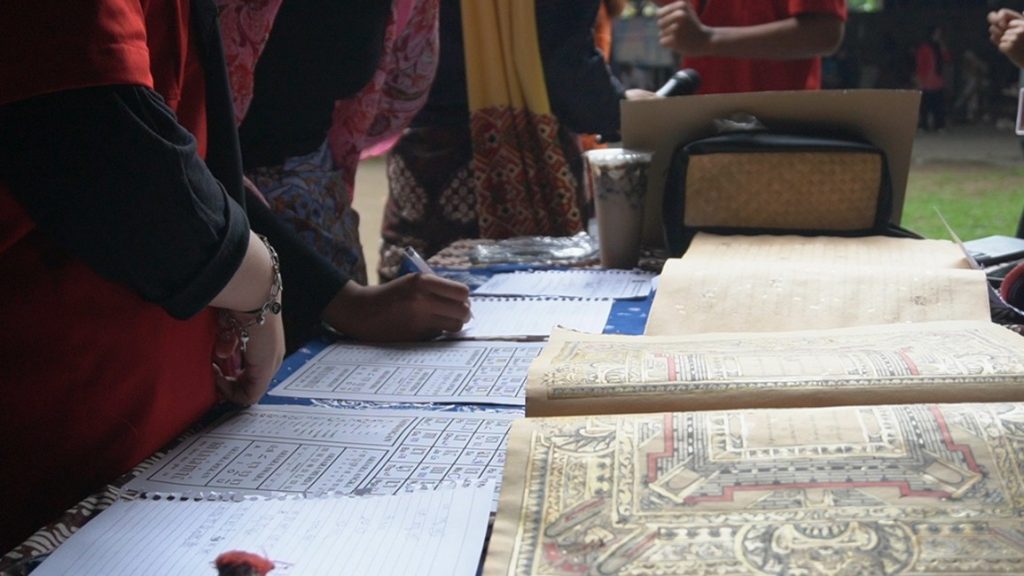
The symposium, held on Thursday, October 16, 2025, at the BRIN Widya Graha Building, began with participant registration at 8:15 a.m. Western Indonesian Time, followed by the opening and panel sessions divided into 11 major themes. In each panel, researchers presented their research results and discussed various aspects of manuscript writing in a scientific manner.
During the session, Dr. Arsanti Wulandari, M.Hum., together with Nanda Nursa Alya, S.S., presented a paper entitled Hybridity of Snacks in Manuscript NB 499: A Linguistic and Cultural Review. The research addressed the theme of “Traditional Knowledge and Technology” by examining a manuscript from the National Library of Indonesia collection labeled R. Aj. Kramahudjana and stamped with the Internationale Crediet en Handelsvereeniging Rotterdam (1931) book stamp.
This study highlights the phenomenon of cultural hybridity—a blend of Javanese and European (Dutch and French) elements—as reflected in the culinary diversity described in the manuscript. One interesting example is the Purpercĕs Pohung snack, which etymologically is a vernacularization of the Dutch word poffertjes (a type of small cake) and the Javanese word pohung (cassava). The phoneme poffertjes was adapted to purpercĕs, demonstrating the dynamics of language and cultural interaction at that time.
The appearance of the Prastila (top right), Bludĕr Pohung (top left), Purpercĕs Pohung (bottom). Documentation by Dr. Arsanti Wulandari, M.Hum.
The participation of the Javanese Language, Literature, and Culture Study Program in the Manassa 2025 event is a tangible manifestation of academics' commitment to preserving Nusantara manuscripts as a relevant source of knowledge for modern life. Through such studies, knowledge from the past is revived to benefit the wider community, in line with the Sustainable Development Goals (SDGs), particularly those related to quality education, sustainable cities and communities, and partnerships to achieve goals.
The Javanese Language, Literature, and Culture Study Program, Faculty of Cultural Sciences, Gadjah Mada University, is once again holding its annual Gugur Gunung 14 event as part of the 70th anniversary of the study program's establishment. Established on September 19, 1955, the Javanese Language, Literature, and Culture Study Program has now entered its seventh decade of research, development, and preservation of Javanese culture in both academic and wider communities.
This year, Gugur Gunung carries the theme Tataning Ucap Sirnaning Dhesti, which means “organizing speech to avoid misfortune.” This theme forms the basis of values in fostering a spirit of mutual cooperation, unity, and togetherness in order to achieve the noble goal of preserving and realizing the sustainability of Javanese language, literature, and culture.
The first series of activities is a Javanese cultural exhibition which will be held on September 17-18, 2025, on the 1st floor of the Margono Building, from 10:00 a.m. to 4:00 p.m. During the exhibition, visitors are invited to explore various forms of Javanese culture through traditional games, gamelan musical instruments, wayang kulit (shadow puppets), ancient manuscripts, and weton (birth date calculations). Visitors can not only observe, but also interact directly and gain knowledge about the philosophical meaning behind each culture on display.
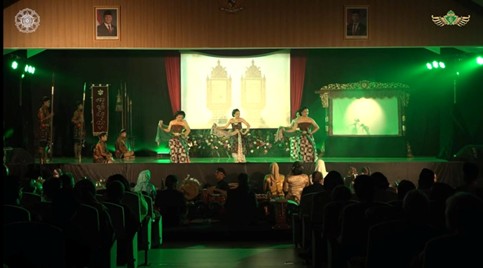
The highlight of the Gugur Gunung 14 event will be held on September 19, 2025, at the Poerbatjaraka Building Auditorium on the 3rd floor. The highlight of the evening will feature a variety of art performances, including classical dance, creative dance, and the dance drama “Adisari: Cahaya Kasih di Balik Penaklukan” (Adisari: The Light of Love Behind Conquest).
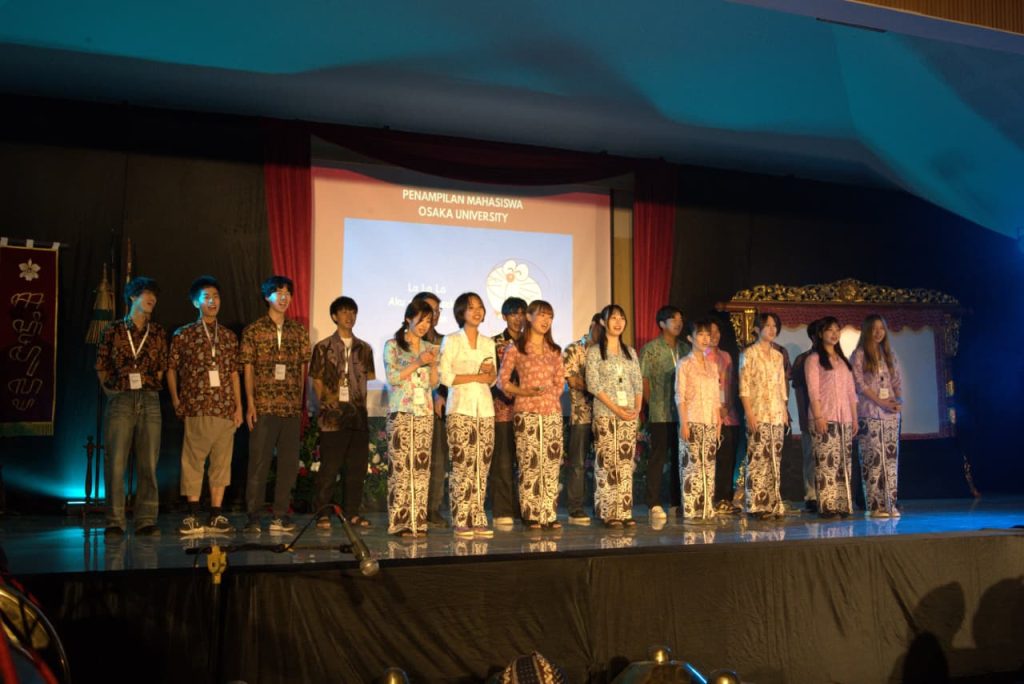
The dance drama was adapted from the text and illustrations of the Babad Metawis Skriptorium Pakualaman manuscript, which was initiated by Sri Paku Alam II. In addition to showcasing the richness of traditional art, the event was made even more special by the collaborative performance of students from Osaka University. It also served as a moment of farewell and appreciation for Dr. Sri Ratna Saktimulya, M.Hum., who was retiring from her position.
The Gugur Gunung 14 event is not just an anniversary celebration, but also a concrete means of preserving and reviving Javanese culture. Through this event, the Javanese Language, Literature, and Culture Study Program affirms its commitment to maintaining the sustainability of the noble values of Javanese culture so that they remain relevant amid the tide of modernity.
Bibliography
Kanal Pengetahuan Fakultas Ilmu Budaya UGM. (2025, 29 September). Alih Wahana Manuskrip Kuna ke Seni Pertunjukan, Adisari: Cahaya Kasih di Balik Penaklukan [Video]. Youtube. Retrieved from https://www.youtube.com/watch?v=gLnTciXTCEg.
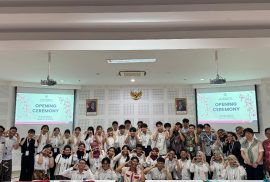
The Department of Javanese Language, Literature, and Culture, Faculty of Cultural Sciences, Gadjah Mada University (UGM), welcomed students from Osaka University, Japan, from September 10 to 20, 2025. For ten days, they studied Indonesian language and explored Javanese culture in Yogyakarta, accompanied by lecturer Prof. Dr. Yumi Sugahara.
Activities included visits to Pakualaman Palace, Wotawati Village, the Jogja Archive Diorama, the Yogyakarta Palace, the Sonobudoyo Museum, Prambanan Temple, and Borobudur Temple. In addition, the Osaka students received guidance from UGM students who acted as tutors and conversation partners on the customs of Indonesian society.
The closing ceremony was held on September 19, 2025, with a presentation of the observation results at FIB UGM. That evening, the Osaka University student group performed at the Gugur Gunung XIV event at the Poerbatjaraka Auditorium, singing two songs, Tsubasa wo kudasai and Doraemon no Uta, in Indonesian. The visit concluded on September 20, 2025, with the students' return to Japan.
This program is a form of strengthening academic cooperation between Gadjah Mada University and Osaka University. It is hoped that this cultural visit will not only be a forum for academic cooperation, but also a place for learning and understanding between cultures. In addition, this activity contributes to the introduction and preservation of cultural values that form the identity of both nations. Thus, this program is in line with the Sustainable Development Goals (SDGs), particularly in the aspects of quality education (point 4) and partnerships for the achievement of common goals (point 17).
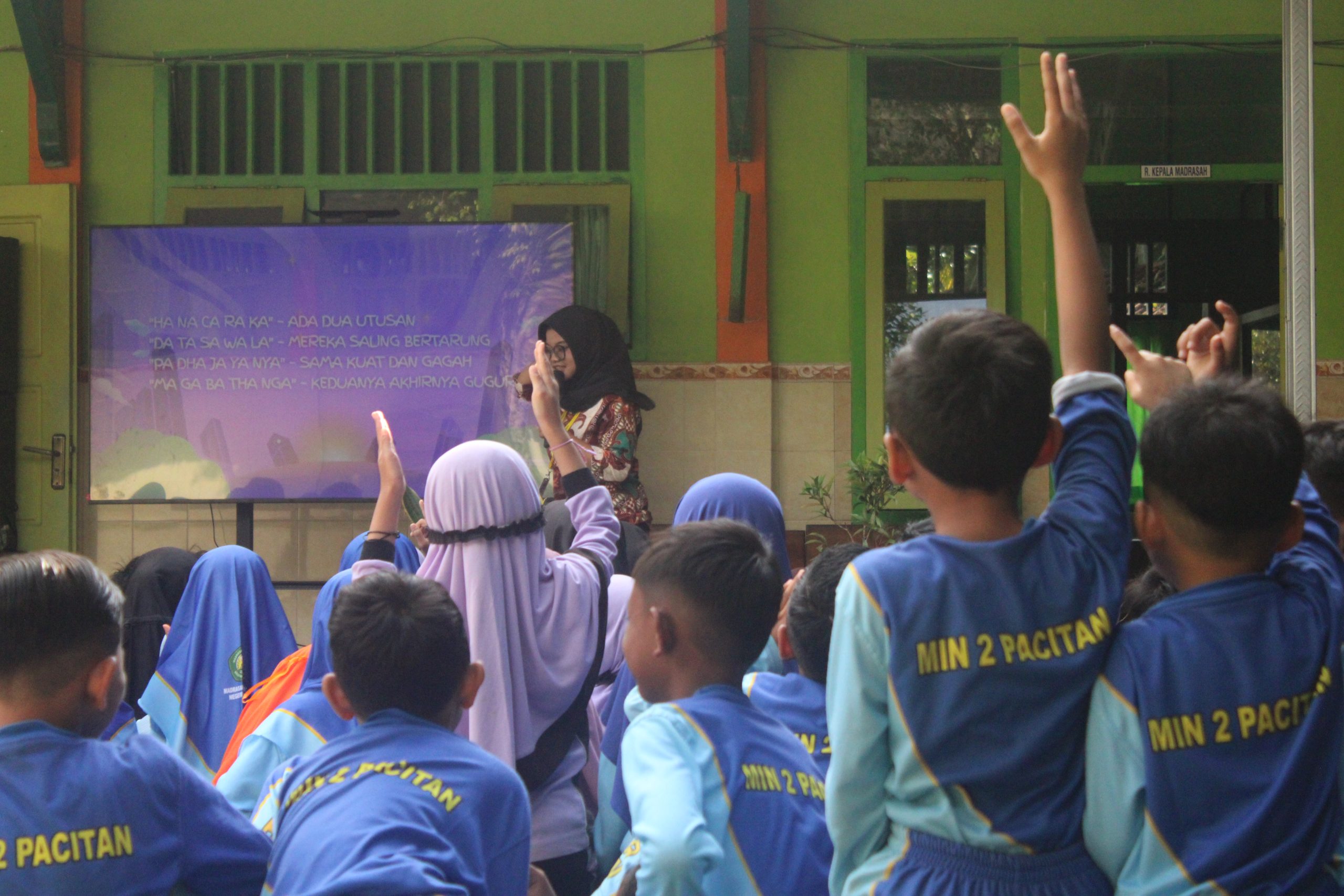
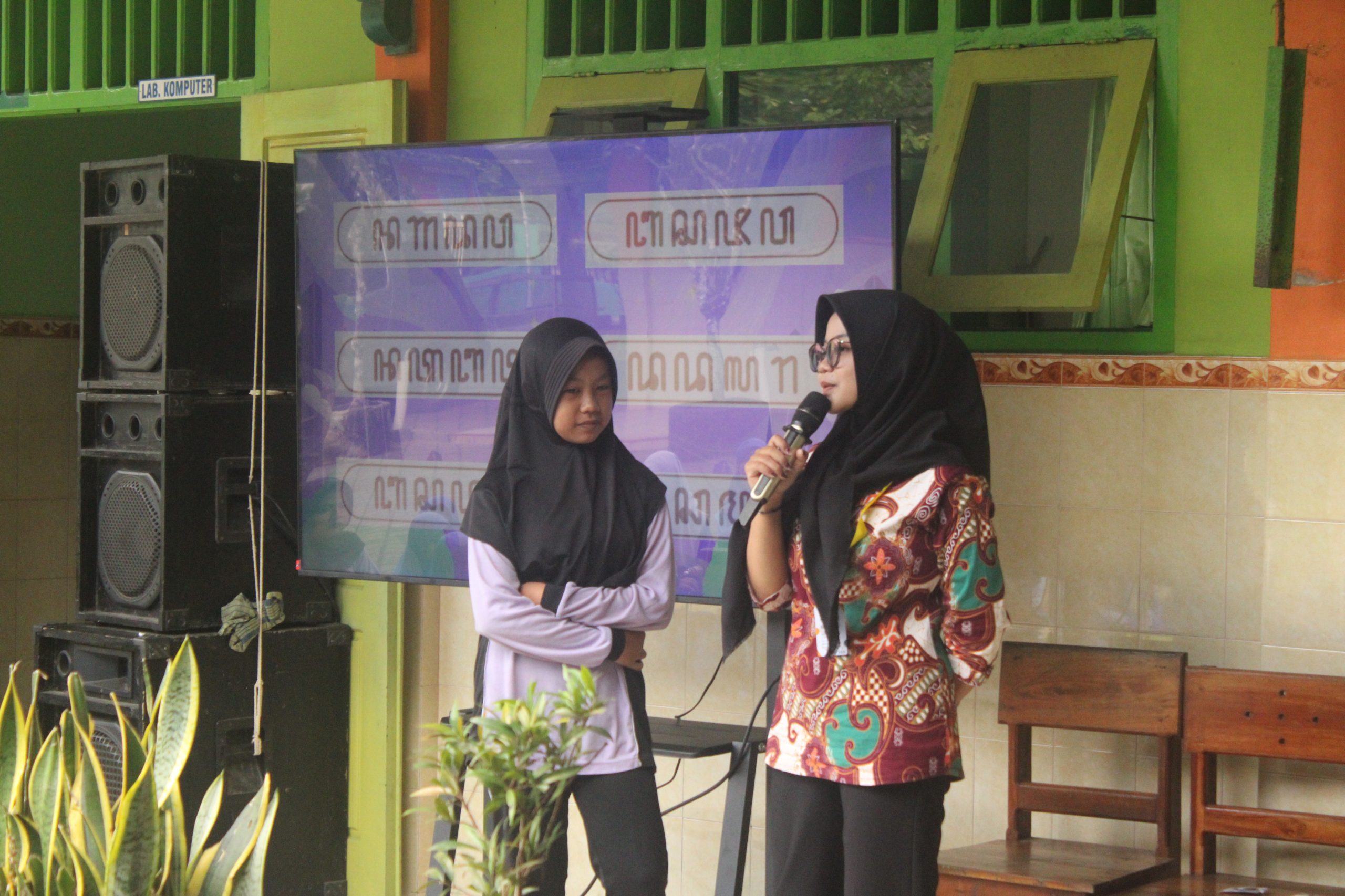
Universitas Gadjah Mada (UGM) is once again implementing the Community Empowerment Field Study Program (KKN-PPM), a student service program that is both an academic tradition and a form of social responsibility for universities towards the community. The 50-day program, running from June 20 to August 8, 2025, places students in various regions to interact with the community, identify needs, and provide creative, science-based solutions. Among the many programs initiated by students, one that stands out is P4 Carakan (Introduction, Learning, Training, and Application of Carakan), a concrete effort to preserve and promote Javanese script in Pacitan Regency, East Java.
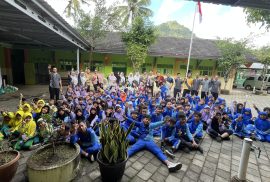
This program was conceived by Dhiny Maulina Mahanani, a student of the Javanese Language, Literature, and Culture Study Program, and implemented at Madrasah Ibtidaiyah Negeri (MIN) 2 Pacitan, Bungur Village, Tulakan District, Pacitan Regency, East Java.
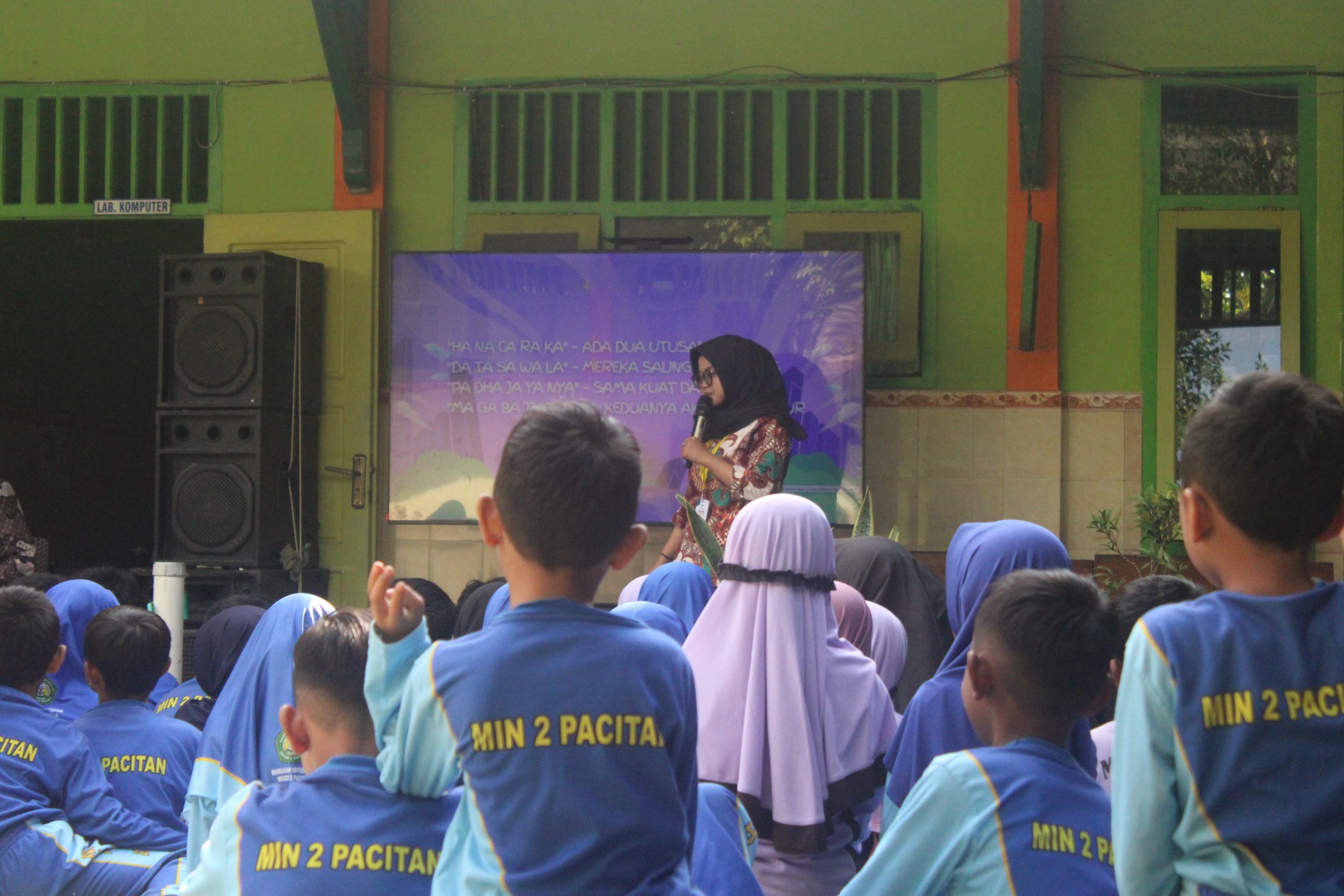
Dhiny explained that the background of this program stems from the low interest of students in learning local content, especially Javanese script, which is often considered complicated. Therefore, he developed a more interactive and enjoyable learning method. The activity began with the screening of an animated video about the history of Javanese script, followed by an introduction to the basics of Carakan, its rules of use, and an interactive quiz with prizes to encourage students to express their opinions. This resulted in increased enthusiasm among students, as evidenced by their active participation and various questions.
“The goal of this program is to dispel the notion that learning Javanese script is difficult, while also increasing young people's interest in local knowledge. This is part of a real effort to preserve Javanese culture,” said Dhiny in an online interview on September 30, 2025.
Initially, the program was planned to be targeted only at third-grade students. However, thanks to the support of the school, the teaching target was expanded to include all students in grades 1-6, with a total of 109 participants. This situation presented its own challenges in implementing the program.
Despite facing challenges in managing a large number of students, Dhiny admitted that interactive methods helped her maintain the participants' focus and enthusiasm. Support from the school was also key to the success of this program. “I am proud and happy to be able to share my knowledge and successfully attract students to learn about local knowledge. I am also touched because all the teachers and students have noticed a change in the students' enthusiasm for learning,” she added.
The presence of the P4 Carakan program is an example of how community service activities can serve to empower the community while also promoting local culture that has begun to be marginalized. The P4 Carakan program is proof that efforts to preserve and revive culture can begin in small classrooms in rural areas. Through continuous cooperation, cultural preservation does not only remain at a symbolic level, but can also find its relevance in the midst of community life, namely as a form of national identity and the cultural wealth of the archipelago.
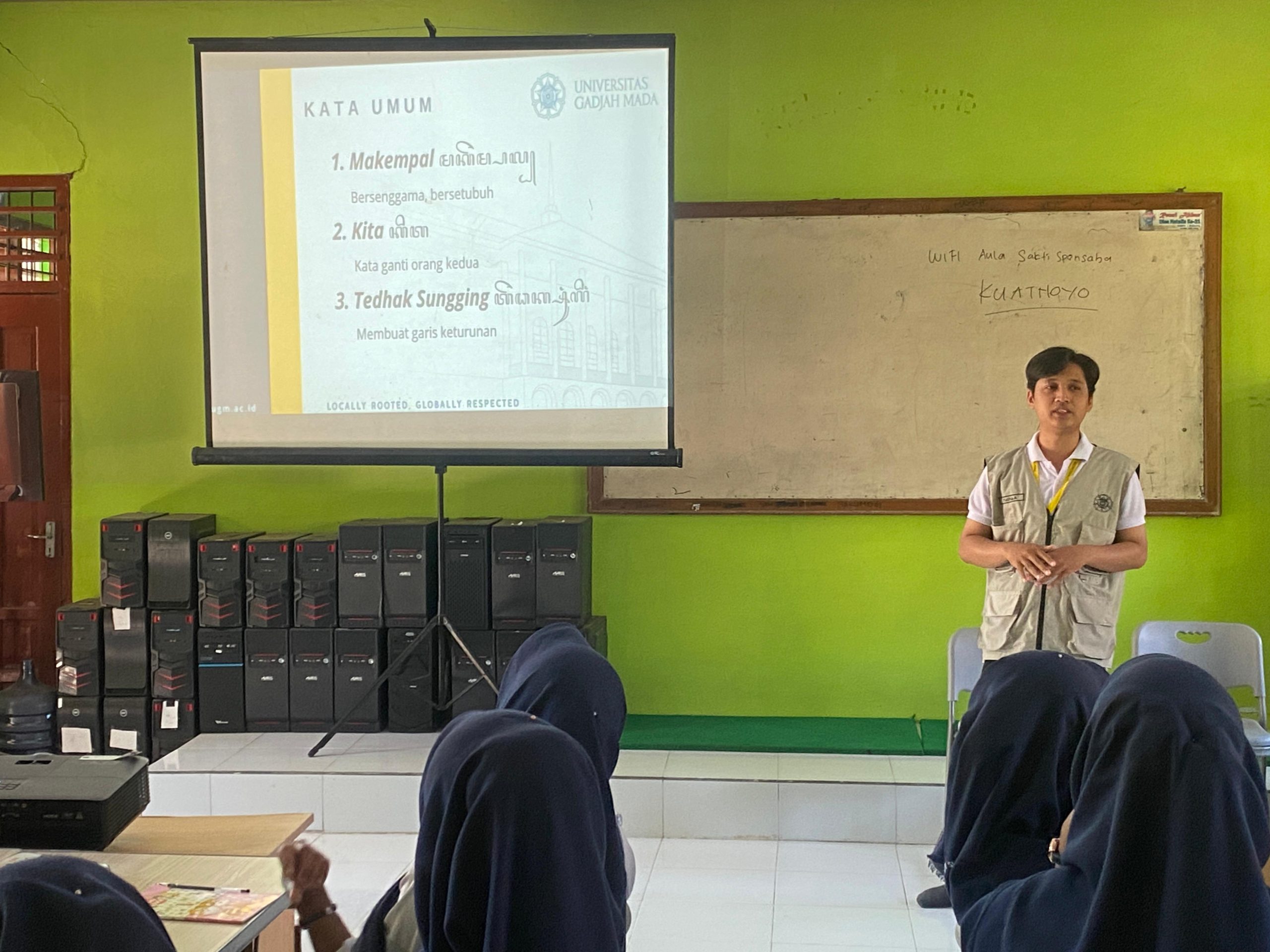
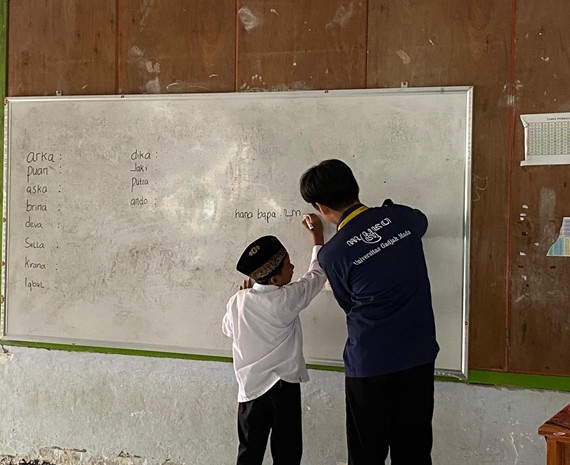
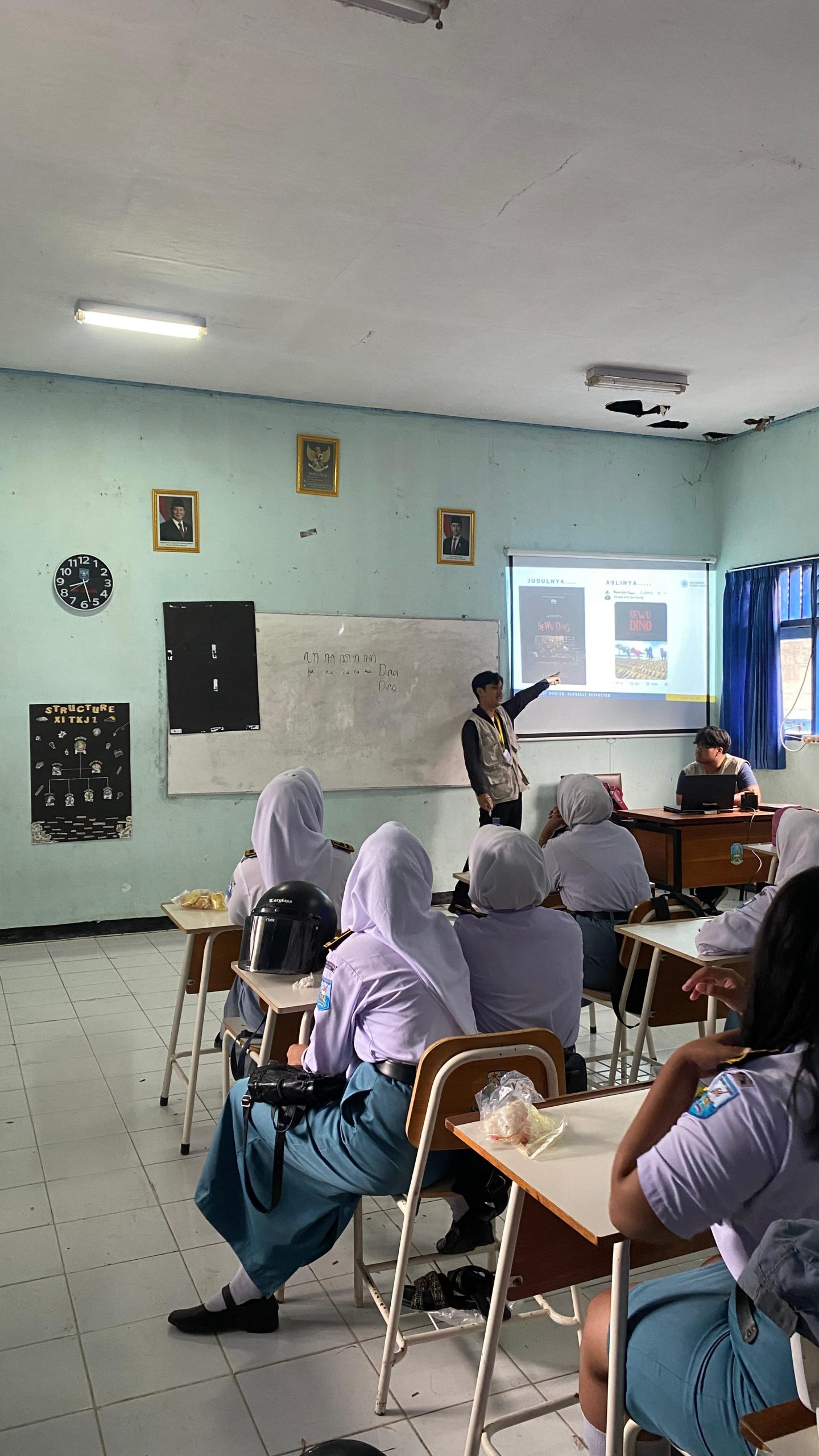
Universitas Gadjah Mada is holding a 50-day Community Empowerment Field Study Program (KKN-PPM) from June 20 to August 8, 2025. In its implementation, students are assigned to serve by carrying out programs aimed at community empowerment. This includes Yudha Adhistira, a student in the Javanese Language, Literature, and Culture Study Program, who is implementing the “Sira Saraja” (Sinau Rame Aksara Jawa) program in Blitar Regency, East Java. This program focuses on socializing the use of Javanese script and language to elementary to high school students in Bululalang Village and Bakung District, highlighting a number of common mistakes, such as the use of the words “makempal” and “tedhak sungging,” as well as errors in writing the names of villages and public places on digital platforms such as Google Maps.
In an online interview on August 31, 2025, Yudha explained that the aim of this program is to reduce misconceptions about the use of Javanese script and language, while fostering motivation and interest among the younger generation in Javanese language objects. “To attract this interest, the material has been designed to be appealing, such as displaying examples of beautiful Javanese manuscripts, conducting case studies of Javanese-language pop works, and introducing the potential of Javanese cultural objects and tourism in the Blitar area,” he explained.
However, the implementation of this program is not without challenges. Yudha revealed that there is still a lack of educators who are experts in the Javanese language and a limited number of student worksheets (LKS) that focus on Javanese script. Nevertheless, the students' enthusiasm was evident through their active questioning and interaction during the activities. "The situation was quite exciting and challenging, especially when presenting new things that could attract the children's interest. Despite some difficulties, the children's enthusiasm through their interactions and many questions about this teaching method is a joy in itself," he added.
The Sira Saraja program also reflects the importance of preserving regional languages as part of national identity. The slogan “language is the soul of a nation” is relevant in efforts to preserve and develop regional languages. The conditions in Bululalang Village and Bakung District are concrete examples of the current state of regional languages, which are becoming increasingly “foreign” to their speakers.
In line with this, in his lecture, Prof. Dr. Hendrokumoro, M.Hum., lecturer in the Javanese Language, Literature, and Culture Study Program and professor of Linguistics at the Faculty of Cultural Sciences, Universitas Gadjah Mada, emphasized the importance of a flexible, enjoyable, and relevant approach to learning regional languages (Hendrokumoro 2025, May 8). This is an important strategy so that regional language learners, especially native speakers, can continue to preserve and revive regional languages as a form of national identity. Therefore, synergy between various parties is needed as a joint effort in the preservation and development of regional languages in Indonesia.
Bibliography
Hendrokumoro. [Universitas Gadjah Mada]. (2025, May 8). Pengukuhan Prof. Dr. Hendrokumoro, M.Hum., Guru Besar Fakultas Ilmu Budaya UGM. [Video]. Youtube. Retrieved from https://www.youtube.com/watch?v=1d6PJDguBFk.
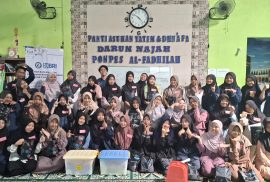
On Sunday (August 24, 2025), HMJ Kamastawa conducted social service and teaching activities at the Darun Najah Orphanage and Shelter for the Poor in Maguwoharjo Village, Depok, Sleman. This initiative, organized by the Social Community Division and the Academic Division, reflects the students' social responsibility and dedication to the community as part of implementing the Tri Dharma of Higher Education. The target audience for the activity was orphaned and underprivileged children, with a focus on educational support for female high school students.
Prior to the social service activity, the Social Community Division opened donations of money and goods, including reading books, stationery, and cleaning supplies. These donations were then distributed to meet the needs of the Darun Najah Orphanage.
The series of events began with a teaching activity guided by the Academic Division with the theme of Javanese script and how to write it. In this session, students presented interactive group games. Participants were asked to answer questions competitively, and each correct and quick answer would earn points. After the game ended, the group with the most points was entitled to a prize.
The event continued with a social service activity by the Social Community Division, which donated snacks and necessities for the orphanage, such as brooms, boxes, and so on. The funds for these necessities were obtained from an open donation that had been opened previously.
The event concluded with a symbolic presentation of commemorative plaques and the handover of donations from the chairman of HMJ Kamastawa to representatives of the Darun Najah Orphanage management. Students and orphanage children also took part in a group photo session to commemorate the occasion and share stories.
Kamastawa's community service activities are not merely about carrying out work programs, but also provide a shared learning space that offers valuable experiences for both students and children at the orphanage. In addition, these activities support the achievement of the Sustainable Development Goals (SDGs) in the areas of health, education, equality, and sustainable communities and partnerships.
On Saturday, May 17, 2025, a student of the Javanese Language, Literature, and Culture study program, class of 2023, Maysa Putri Fatihah, won the 1st runner-up prize in the Javanese Script Literacy competition. This competition was held by Pura Pakualaman in the framework of the 219th (in Javanese year) Hadeging Kadipaten Pakualaman Ngayogyakarta. This year, the Hadeging Kadipaten Pakualaman event carries the theme 'Manggala Gati Wiwaraning Rat'.
This Javanese Script Literacy Competition is divided into two categories, namely General and Students. For the general category, the competition is to translate Latin text into Javanese script and draw rerenggan/illustrations according to the participants' interpretation of the contents of the text. The questions are in the form of macapat songs from the Sestra Ageng Adidarma manuscript text collected by the Widyapustaka Pakualaman Library. This text contains 6 verses of the Durma song, all of which must be depicted in the renggan, but only the first verse is translated. The text was given when the registration was announced, so participants could prepare illustration ideas well in advance.
On the day of the event, participants were given 5 hours to complete the work. During the process, participants were prohibited from opening their cellphones, copying letters, or plagiarizing images. The committee only provided drawing paper with Pakualaman stickers to minimize cheating.
Maysa's work itself has a deep meaning. She mentioned in the description of her rerenggan that the color red symbolizes courage, while blue symbolizes peace and noble character. In the ornament under the renggan, a circle is depicted which has the meaning of rat or universe. In addition, there are ornaments of cannons, arrows, and spears as weapons of war. These weapons of war symbolize a source of strength or support to achieve victory.
Apart from Maysa, there were 2 other students from the 2023 batch who took part in this competition, namely Rafi Nur Fauzy and Rafif Wicaksono. Both are among the top 10 nominees with the best works. By participating in this competition, it is hoped that students can love and appreciate the literary works left by our ancestors more.
"It certainly feels happy to have the opportunity to participate in the Javanese script literacy competition and win. It's great to meet great people there (especially philologists). Alhamdulillah, I was able to bring home the trophy from Pakualaman and make my parents proud. Hopefully, my other friends will be motivated so that in the next opportunity they can participate and compete together," said Maysa.
Ahead of the first course registration through the Simaster system, the Student Association of the Study Program of Javanese Language, Literature, and Culture, Faculty of Cultural Sciences, (HMJ Kamastawa), held an information session on the Credit Study Plan (KRS) system and curriculum for new students of the 2025 cohort. The event took place on Tuesday, August 12, 2025, from 1:00 p.m. to 3:00 p.m. Western Indonesian Time in room M403, 4th floor, Margono Building, FIB UGM. The socialization aimed to reduce confusion among new students in filling out the KRS, which was scheduled to take place on Thursday–Friday, August 14–15, 2025.
The information session was presented by Meifira Arini Pitaloka, or familiarly known as Fifi, as the Head of the Academic Division of HMJ Kamastawa. She explained various important information related to lectures, ranging from courses and the number of credits, the mechanism for taking and canceling courses, the use of Simaster, to understanding the curriculum.
In her presentation, Fifi used a creative method by presenting comic strips as visual aids. This method succeeded in increasing the attention and enthusiasm of the new students. The socialization atmosphere was serious but still interactive, as evidenced by the many questions asked by participants to the presenter.
Through this activity, new students are expected to have a clear understanding of how to fill out their course registration forms and gain initial knowledge about the dynamics of university life. HMJ Kamastawa affirms its commitment to continue assisting students in their academic adaptation and campus life.
Asosiasi Pendidikan Bahasa, Sastra, dan Budaya Daerah (ADISABDA) held its 4th National Coordination Meeting (RAKORNAS) and INCOLWIS International Seminar at the Santika Hotel, Surabaya, on August 12–14, 2025. This national forum was attended by the heads of study programs and administrators of regional language, literature, and culture study programs from various universities in Indonesia. The three-day event discussed the papers and presentations of the seminar participants, followed by a national coordination meeting (RAKORNAS). The RAKORNAS activity was carried out to align perceptions and formulate Graduate Learning Outcomes (CPL) so that regional language, literature, and culture education standards can be integrated nationally.
The Head of the Javanese Language, Literature, and Culture Study Program was present to represent the program at the Incolwis seminar and the ADISABDA IV National Working Meeting. On this occasion, the UGM Javanese Language, Literature, and Culture Study Program signed a memorandum of understanding (MoU) with the Javanese Language and Literature Education Study Program at Surabaya State University (UNESA). This signing is a concrete step to strengthen academic cooperation and curriculum development, while also reinforcing a shared commitment to preserving and developing regional languages, literature, and culture at the national level.
Another proud achievement has been made by cultural studies students (mahadaya) at Gadjah Mada University (UGM). Muhammad Siswoyo, a student in the Javanese Language, Literature, and Culture Study Program, Faculty of Cultural Sciences, won second place in the Kencana Sastra essay competition held by the Javanese Language Education Study Program Student Association, Sebelas Maret University (UNS).
The competition carried the theme “Kabudayan Jawa Nut Larasing Jaman, Tan Bisa Sirna Ing Kasejaten” (Javanese Culture Remains Relevant, Cannot Be Erased from Reality) with three main sub-themes, namely tradition, Javanese cultural values, and knowledge and technology. The series of activities began on May 3, 2025, with the winners announced on May 31, 2025.
In this event, Siswoyo wrote an essay titled “Tutur-Tulis-Pakeliran-Visual: Ekranisasi Repertoar Wayang sebagai Kontinuitas Inovasi Manuscript Digitazion menuju Pertunjukan Kontemporer berbasis Technological.” (Tutur-Tulis-Pakeliran-Visual: The Screen Adaptation of Wayang Repertoire as a Continuation of Manuscript Digitization Innovation toward Contemporary Performances Based on Technology). The work highlights the process of screen adaptation of wayang, starting from old digitized manuscripts, then staged in the form of conventional wayang, to being transformed into cinema wayang. This idea is considered a form of innovation and an offer of renewal so that wayang remains relevant and can be enjoyed by various groups in Indonesia.
In an online interview on August 20, 2025, Siswoyo expressed his deep impression of participating in the competition. “It was exciting. The new theme emphasized cultural relevance. More than relevance and innovation, basic cultural knowledge should be the main point in writing,” he said.
Furthermore, he encouraged his fellow students not to hesitate to participate in various competitions and external activities. “Stay enthusiastic. Don't be shy to be dynamic in competitions or external activities. All students have the same rights. There are many opportunities waiting for you,” he added (08/20/2025).
Siswoyo's achievement is expected to inspire students of the Javanese Language, Literature, and Culture Study Program, as well as the younger generation in general, to continue to excel while preserving the cultural heritage of the archipelago. Culture, as the intellectual wealth of the nation, needs to be continuously preserved and revitalized so that it can continue to benefit society. This is in line with the goals of sustainable development (SDGs), particularly quality education (point 4), sustainable cities and communities (point 11), and partnerships to achieve goals (point 17).