• University
  • Academic Portal
  • University Library
  • Webmail
  • Arnawa
  • UM UGM
  • English
    • Bahasa Indonesia
    • English
Universitas Gadjah Mada Javanese Language, Literature, and Culture Program
Department of Language and Literature
Faculty of Cultural Sciences
Universitas Gadjah Mada
  • Home
  • Profile
    • Vision & Mission
    • Objective
    • Excellence
    • Career Prospects
    • Teaching Staff
  • Academic
    • Curriculum Flow
    • Courses Description
    • Distribution of Courses
    • Academic Calendar
    • COURSE AND ADMINISTRATION INFORMATION
    • Learning Outcomes
    • INTERNATIONAL CONFERENCES AND ACTIVITIES
  • KPPB
    • Collaboration
    • Research
      • Teaching Staff Research
      • Javanese Studies Archive – Arnawa
    • Service
      • Community Services
      • Podcast (Anarka Lālitya)
    • Scholarship
  • Student Affair
    • Student Satisfaction Survey
    • HMJ Kamastawa
    • Student’s Activity
    • Student’s Creations
    • Youtube Channel
    • Instagram
  • Alumnus
    • Alumnus Profile
  • Contact
  • Home
  • College Student
  • 3rd Place in Temu Budaya Nusantara (TBN) XXX’s Storytelling Competition: The Selected Stories and the Stories Behind Them

3rd Place in Temu Budaya Nusantara (TBN) XXX’s Storytelling Competition: The Selected Stories and the Stories Behind Them

  • College Student, Student's Work
  • 28 February 2025, 14.19
  • Oleh: fegaachilleamaydena
  • 0

During the 30th Temu Budaya Nusantara (TBN), a new Javanese Language, Literature, and Culture student from the 2024’s batch took part in the competition as a delegate and immediately came out on top! Who is the winner? Let's take a peek at the story!

Ghibran Arsha Daffa' Musaffa' is the 3rd place winner of the Storytelling Competition held at the 30th TBN in 2024. Although Ghibran is a new student, this did not dampen his determination to compete in this national competition. Ghibran said that as soon as he heard that a national storytellers competition would be held and he could represent Universitas Gadjah Mada, he was immediately interested to join.


Initially, the theme he wanted to take was children's games (dolanan anak). Ghibran had even arranged the storyline of the story in such a way. However, after consulting with an elementary school teacher in Yogyakarta, it turned out that the story was considered less relevant to youngster. The teacher finally suggested a romance theme, but it could be connected to culture. Finally, the theme chosen was jathilan. Ghibran stated that this story was inspired by the story of Dr. Inggar Bagus Wibisono. A doctor, jathilan dancer and an Keraton’s abdi dalem all at once. The synopsis of the story is as follows.
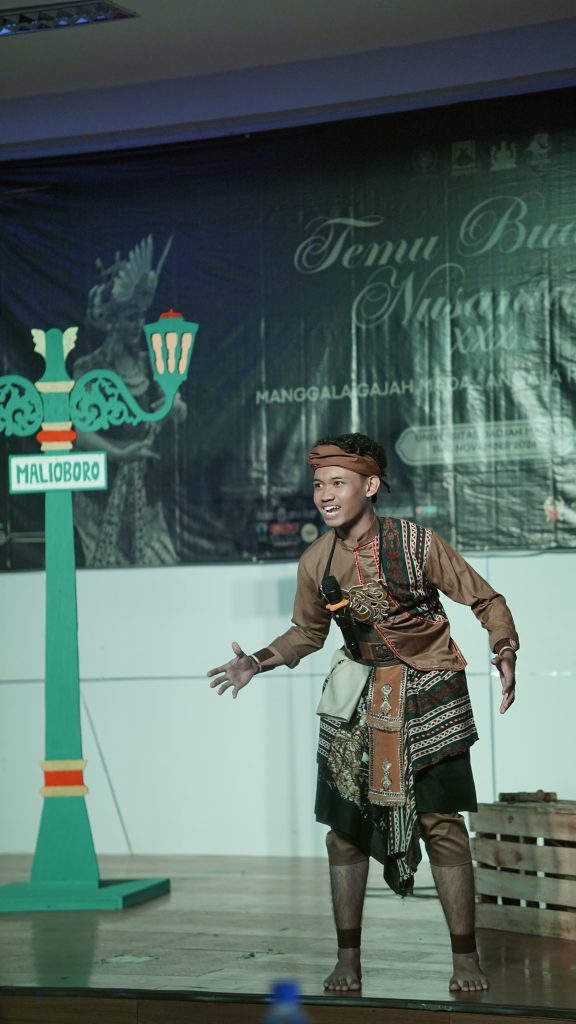
There are 2 college students who are dating named Joko and Wati. Wati is said to like things that have to do with culture and has the opinion that she must take part in preserving and maintaining culture, especially Yogyakarta culture. The peak of the conflict takes place in Malioboro where Joko finally finds out that Wati is a jathilan player. Here Joko represents the thoughts of the people who like to swallow the stigma about jathilan raw. However, Wati still chooses to break up with Joko and preserves the jathilan dance and becomes a skilled dancer, to the point of being nicknamed Nyai Rangga Wati.


However, there is a unique fact, namely that Ghibran is actually afraid of jathilan! Even now, when he hears the accompaniment of jathilan gamelan, he still feels nervous because in the past there was an incident where a jathilan dancer almost wanted to enter his house, hihihi. So the process of making this fairy tale is one of Ghibran's ways to get out of his comfort zone. For the sake of this fairy tale, Ghibran was willing to observe and interview female jathilan figures.


Ghibran got a lot of things from this TBN XXX event. Ghibran is grateful because he became brave enough to try new things and put aside his fear. Ghibran also got new friends, even from Bali. Although at the beginning of the event Ghibran felt afraid, because of his father, Ghibran was convinced to try his best because winning or losing is a later matter.


From Ghibran we can learn that in order to achieve what we want, we must put in a lot of effort. In addition, as young people, Ghibran gives an example that we can create cultural-themed works and clear the negative stigma that has been attached to the culture. Finally, there is a message from Ghibran that young people should not be ashamed to preserve their own culture. Because if we don't preserve it, who else will?

Tags: SDGS 11: SUSTAINABLE CITIES AND COMMUNITIES SDGS 17: PARTNERSHIPS FOR THE GOALS STUDENTS' WORK TEMU BUDAYA NUSANTARA XXX

Leave A Comment Cancel reply

Your email address will not be published. Required fields are marked *

*

Recent Post

  • The Challenge Facing Young Puppeteer Rafi Nur Fauzy in Performing Wayang Gedhog on National Puppetry Day
    December 4, 2025
  • HMJ Kamastawa Grand Meeting: Wreksi Pinandhita Elected as Chairperson for the 2026 Term
    December 4, 2025
  • Exploring the Types and Meanings of Sesajen Culture in the Javanese Language, Literature, and Culture Study Program Workshop
    November 28, 2025
  • Comparative Study of Javanese Literature at UNNES and Javanese Language, Literature, and Culture at UGM: Strengthening Friendship and Collaboration for Sustainable Javanese Culture
    November 13, 2025
  • Discussing the Relevance of Javanese Literature Today in Javanese Literature History Lectures
    November 11, 2025

Calender

January 2026
M T W T F S S
 1234
567891011
12131415161718
19202122232425
262728293031  
« Dec    
  • Fakultas Ilmu Budaya
  • Ujian Masuk UGM
  • PPSMB
  • Alumni
  • Jurnal Humaniora
January 2026
M T W T F S S
 1234
567891011
12131415161718
19202122232425
262728293031  
« Dec    

News

  • The Challenge Facing Young Puppeteer Rafi Nur Fauzy in Performing Wayang Gedhog on National Puppetry Day
    December 4, 2025
  • HMJ Kamastawa Grand Meeting: Wreksi Pinandhita Elected as Chairperson for the 2026 Term
    December 4, 2025
  • Exploring the Types and Meanings of Sesajen Culture in the Javanese Language, Literature, and Culture Study Program Workshop
    November 28, 2025
Universitas Gadjah Mada

Javanese Language, Literature, and Culture Program
Department of Language and Literature
Faculty of Cultural Sciences
Universitas Gadjah Mada


Sosiohumaniora St., Bulaksumur, Yogyakarta
Telp : 0274-901134 Ext. 110, Fax : 0274-550451, WhatsApp : 081211911281
Email : nusantara@ugm.ac.id

© 2025 Javanese Language, Literature, and Culture Program FIB UGM

KEBIJAKAN PRIVASI/PRIVACY POLICY