- Home
- Post by
- page. 13

haryountoro



Abhiseka Kramasisya 2021
College StudentNewsSDGSStudentStudent's ActivityStudent's Work Tuesday, 3 October 2023
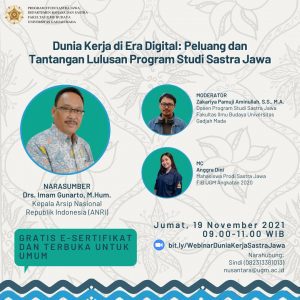
Abhiseka Kramasisya is an inauguration event for new students of the Javanese Literature Study Program. In 2021, the event was held in October and was attended by 35 new students of the Javanese Literature Study Program. This year's Abhiseka Kramasisya event carries an interesting theme, namely "Manata, Marsudiya, Manunggaling Asta".
The meaning of the theme above is "Manata" which means organizing or making preparations, both setting goals or preparing oneself (mentally and physically), as well as preparing plans.
"Marsudiya" is a mandate that we try our best to achieve the desired goals. Don't give up and give up easily even though you are going through obstacles in the process that you are going through.
Meanwhile, "Manunggaling Asta" means joining hands which has the meaning of praying. Through prayer we can surrender everything we have done and fully surrender to God for the final results we receive. "Manunggaling Asta" can also mean joining hands. A figure of speech which means to strengthen the family, either with younger or older people. In addition, we can also refer to the word “manunggal” which means one, and the word “asta” which means two as sengkalan for the year 21 or 2021.
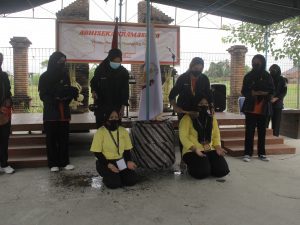
The Abhiseka Kramasisya program was divided into three series of events, namely the "Nglaras Memitran and Study Program Seminar" which was held on October 23, 2021, followed by the "Nglaras Karsa" event which was held on October 24, 2021, and ended with the main event, namely "Inauguration of New Students" on October 30, 2021.
The implementation of the first series of activities began with the opening of the event by the presenter followed by the inauguration of the opening of the activities by the Head of the Javanese Literature Study Program, Dr. Daru Winarti, M.Hum. Then, continued with "Nglaras Karsa" which is an introductory activity, both from new students and the lecturers and event committee. After that, it was closed with the last event "Seminar Study Program", namely the presentation of three specializations in Javanese Literature by Dr. Hendrokumoro, M. Hum. (majoring in linguistics), Dr. Sri Ratna Saktimulya, M.Hum. (majoring in philology), and Dr. Wisma Nugraha Christianto R., M.Hum. (literary major). The series of activities on the first day were carried out online via Zoom Meeting.
The implementation of the second day's activities began with the opening of the activity by the presenter. After that, it was followed by the "Nglaras Karsa" activity, which was a talk show with Javanese Literature alumni, namely Fajar Wijanarko, S.S. and Kezia Permata S.S. The two alumni gavesharing experience as welltips The world of lectures is very interesting to follow. The second day of the event was also held online via zoom meeting.
Meanwhile, the series of events on the third day were carried out offline and in collaboration with the Tembi Rumah Budaya Museum. The implementation of the event on the third day began with an opening ceremony led by the chief executive, namely Amabilita C. S. Then, it was continued with a museum tour guided by Tembi Rumah Budaya Museum officers. The event continued with activitiesmini games as well as the main event, namely the inauguration of new students. After that, it was continued with an art appreciation performance by Javanese Literature Class 2021 friends, giving impressions of messages and closing with a group photo session.
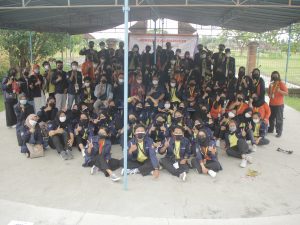
The entire series of Abhiseka Kramasisya events for three days is expected to provide learning and a good impression on Javanese Literature class 2021 friends. With the confirmation of Javanese Literature class 2021 friends as part of the Javanese Literature Student Family (KAMASTAWA), one day they will be able to dynamically and process together to become quality students.
In September 2021, the Javanese Literature study program will hold a public lecture on Sanskrit entitled "Short Course of Basic Sanskerta”. The lectures were held twice in September, namely on the 11th and 18th. The keynote speaker at the Sanskrit public lecture was Prof. Viroopaksha V. Jaddipal. He is a professor from India. The participants of the public lecture were the general public, especially students of the Javanese Literature study program.
Of the many materials related to Sanskrit, the material discussed at the meeting was the basic material of Sanskrit, two of which were the correct way of pronouncing Sanskrit words and knowledge of how to use the right words in composing a sentence. The public lecture was attended by a large number of participants. Although most of the participants were students from educational backgrounds in Javanese literature, there were also several participants from outside the field of Javanese literature.
Through these public lectures, many things can be learned. Not only about how to learn Sanskrit properly and correctly, but it also serves as a reminder for us that learning other languages is also necessary to support success in learning activities. As stated by one of the 2020 Javanese Literature study program students, Muhammad Ikhsan, he is happy to be able to learn Sanskrit with experts directly. Sanskrit, which was initially difficult, became understandable enough through this public lecture.
Multi-language ability is indeed not the main thing for the general public, but for the academic community, especially students who want to explore deeper knowledge, multi-language ability is very necessary. Through this ability, it will make it easier for students to study sources of knowledge in other languages, so that they will have an increasingly broad knowledge. In this case, multi-language is also useful as career support. The ability to multi-language is a separate consideration for companies providing work, especially in an increasingly modern era like today.
Based on the Decree of the Rector of Universitas Gadjah Mada Number 1286/UN1.P/KPT/HUKOR/2022, the Javanese Literature Study Program officially changed its name to the Javanese Language, Literature and Culture Study Program. The change in the name of the Study Program took place on Monday, November 28, 2022. However, the name change of the Study Program is not the first time this has happened. In its history, the development of the Javanese Language, Literature and Culture Study Program cannot be separated from the history of Universitas Gadjah Mada itself.
Referring to the article Knowing the Department of Literature and Culture of UGM by Prof. Dr. Darusprapta (1980), in 1946 there was a foundation called "Jajasan Balai Perguruan Tinggi Gadjah Mada" in Yogyakarta which had two parts:
- Faculteit Law and Economics, with Prof. Dr. Djaka Soetana as chairman.
- Faculteit Sastra, Filsafat, dan Kebudayaan, with Prof. Dr. R. Prijana as chairman.
At that time, the courses organized did not yet reflect certain majors. However, courses in New Javanese Language and Literature and courses in Old Javanese Language and Literature, which were combined with courses in Sanskrit, were offered.
However, from the end of 1946 to the end of 1949, lectures were stopped because Yogyakarta was occupied by the Dutch military. In late 1949, the "Jajasan Balai Perguruan Tinggi Gadjah Mada" merged with the College of Engineering in Jetis, Yogyakarta; the College of Medicine in Klaten; and the College of Political Science in Sala, to become Universitas Negeri Gadjah Mada. The merger was inaugurated on December 19, 1949, which was later determined as its anniversary date.
After the merger, the Faculty of Literature, Pedagogics, and Philosophy was inaugurated on January 23, 1951, with the following departments:
- Eastern Literature
- Western Literature
- History
- Earth Sciences
- Pedagogics
The lecture center was located in Bulaksumur, which later became SD / SMP IKIP Yogyakarta. In 1951-1955, the Faculty of Literature, Pedagogics, and Philosophy was chaired by Prof. Drs. Abdullah Sigit.
On 19-09-1955, to complete the composition of Gadjah Mada University, the Faculty of Literature, Pedagogics, and Philosophy then became:
- Faculty of Literature and Culture
- Faculty of Pedagogics
- Faculty of Philosophy
The Faculty of Letters and Culture building is centered at Dalem Wijilan, Yudanegaran 37, Yogyakarta. The Faculty of Literature and Culture was chaired by Prof. Dr. RMNg. Poerbatjaraka in 1955-1960, who was also the Chairman of the Faculty of Letters, Airlangga University (Udayana). The Faculty of Literature and Culture had the following departments:
- Eastern Literature
- Western Literature
- History
- Earth Science
In the Department of Eastern Literature, there are sub-majors of Indonesian Literature and sub-majors of Javanese Literature at the doctoral level which then in 1958/1959 the sub-major of Indonesian Literature became the Department of Indonesian Literature chaired by Prof. Drs. Siti Baroroh Baried, and the sub-major of Javanese Literature became the Department of Javanese Literature chaired by Dra. Sukesi Adiwimarta. At the doctoral level of the Javanese Literature Department, New Javanese expertise and Old Javanese expertise were opened. At that time, one student was enrolled in the Javanese Literature Department.
Prof. Dra. Siti Baroroh Baried lan became dean in 1962-1966 and the Department of Javanese Literature was chaired by Drs. M. Ramlan who was the first graduate of the Department of Eastern Literature, Faculty of Literature and Culture, Gadjah Mada University (1958).
In 1964, the Javanese Literature Sub-Department of the Eastern Literature Department graduated a bachelor and in the same year, the Javanese Literature Department changed its name to the Nusantara Literature Department in the hope that the range of knowledge that could be achieved would be wider. At the doctoral level, there are three fields of expertise in the Nusantara Literature Department, namely:
- Phlology
- Literature
- Lingustics
In 1965, the faculty building was moved from Dalum Wijilan Yudanegaran to Karangmalang (now IKIP Negeri Yogyakarta complex). In 1966, the Nusantara Literature Department graduated a bachelor with expertise in Javanese Kuna.
In 1967-1969, the Nusantara Literature Department was chaired by Prof. Dr. Darusuprapto, who was a graduate of the Eastern Literature Department (1964). In 1970-1971, the Nusantara Literature Department was chaired by Drs. Sumarti Suprayitna, a graduate of the Eastern Literature Department (1960) who focused her expertise on Old Javanese language and literature.
On July 1, 1970, the Faculty of Literature and Culture occupied a new building in Gadjah Mada University, Bulaksumur. In 1972-1975, the Department of Archipelago Literature was chaired by Drs. RS. Subalidinata, the first graduate of the Department (1969), who graduated a scholar with expertise in philology.
In the 1976-1977 management period with Dean Drs. Djoko Soekiman, and Head of Department Darusuprapta, the Nusantara Literature Department graduated four scholars. In the next management period, 1976-1979, with Dean Drs. Djoko Soekiman and 1980-1981 with Dean Prof. Dr. Sulastin Sutrisno, the Nusantara Literature Department was chaired by Dra. Sumarti Suprayitna.
The Nusantara Literature Department has been using the credit system since 1974. In 1980, the credit system for S1 and S2 programs began to be implemented with the following division:
- Bachelor Studies with 120 credits
- Bachelor (S1) with 160 credits
- Postgraduate (S2) with 194 credits
In the Bachelor study level (S1), there is a division of expertise in Ancient Java, Middle Java and New Java in the fields of Philology, Literature, and Linguistics.
Based on article 2 of the Decree of the Minister of Education and Culture of the Republic of Indonesia Number: 0553/0/1983 concerning Types and Number of Departments in Faculties within the University of Gadjah Mada, the Nusantara Literature Department was then officially renamed the Regional Literature Department.
In 2005, the Department of Regional Literature again changed its name to Nusantara Literature. This was followed by the change of KMSD (Keluarga Mahasiswa Sastra Daerah) to KAMASUTRA (Keluarga Mahasiswa Sastra Nusantara) on March 3, 2005 (admin, 2014). Evidence of these changes can also be found in the UGM Humanities Journal. On the back cover of the Journal of Humanities Volume 17, Number 1, February 2005, the department's name is still listed as Regional Literature. However, on the back cover of the Journal of Humanities Volume 17, Number 2, June 2005, the name of the department has changed to Nusantara Literature.
Based on Annex II in the Decree of the Rector of Universitas Gadjah Mada Number 437/P/SK/HT/2010 on the Arrangement and Reassignment of Permits for the Implementation of Study Programs at Universitas Gadjah Mada issued on July 5, 2010, the name "Sastra Nusantara" is still officially the name of the Department until November 20, 2012.
In an interview with Imam Prakoso, S.S., M.A., a lecturer in the Javanese Language, Literature and Culture Study Program with a focus on Linguistics, in 2010 a change in the title "department" to "study program" was made. In addition, he said that the study program was still named "Nusantara Literature Study Program", but there was an addition in the form of "Javanese Literature Study".
Based on appendix I in the Decree of the Rector of Universitas Gadjah Mada Number 1184/P/SK/HT/2012 concerning the Extension of Permits for the Implementation of Diploma IV, Undergraduate, and Professional Study Programs at Universitas Gadjah Mada issued on October 1, 2012, the name of the department "Nusantara Literature" was again extended until the period of September 30, 2016.
Then, in appendix II in the Decree of the Rector of Universitas Gadjah Mada Number 1718/UN1.P/SK/HUKOR/2017 concerning the Naming of Study Programs at Universitas Gadjah Mada, issued on November 16, 2017, the Nusantara Literature Study Program officially changed to the Javanese Literature Study Program.
Then, the change in the name of the Study Program was carried out again according to the information in the first paragraph, namely on November 28, 2022, according to attachment I in the Decree of the Chancellor of Universitas Gadjah Mada Number 1286/UN1.P/KPT/HUKOR/2022, the Javanese Literature Study Program officially changed its name to the Javanese Language, Literature and Culture Study Program.
Based on an interview with the Head of the Department of Language, Literature and Culture, Dr. Daru Winarti, M.Hum., the change in the name of the Javanese Literature Study Program to the Javanese Language, Literature and Culture Study Program is because the discussion of "Java" cannot only be related to literature, but cultural elements are also contained in it.
In line with this opinion, Rudy Wiratama S.I.P., M.A., a lecturer in the Javanese Language, Literature and Culture Study Program who focuses on the field of literary studies, explained that literary aspects cannot be separated from cultural aspects. In fact, according to him, there is a possibility for an additional field of study, namely the field of cultural studies.
For further explanation regarding the reasons, description, future outlook, and expectations of the Javanese Language, Literature and Culture Study Program, please visit the following link.
Timeline
The following is a timeline of the official name of this Study Program from time to time:
- Faculty of Literature, Pedagogics and Philosophy (March 03, 1946 – December 18, 1949)
- Department of Eastern Literature, Faculty of Literature, Pedagogics and Philosophy (2 January 23, 1951)
- Department of Eastern Literature, Javanese Literature Sub-Major at doctoral level, Faculty of Literature and Cultural Science (September 19, 1955)
- Department of Javanese Literature, Faculty of Literature, Pedagogics, dan Phylosophy (1958/1959)
- Department of Nusantara Literature, Faculty of Literature and Cultural Science (1964)
- Department of Local Literature, Faculty of Literature (1983)
- Department of Nusantara Literature, Faculty of Cultural Science (2005)
- Javanese Literature Program, Faculty of Cultural Science (November 16, 2017)
- Javanese Language, Literature, and Culture Program, Faculty of Cultural Science (November 22, 2022)
Source
Admin. (2014, March 3). Keluarga Mahasiswa Sastra Nusantara. FIB. https://fib.ugm.ac.id/keluarga-mahasiswa-sastra-nusantara.
Admin. (2023, July 31). Sejarah. FIB. https://fib.ugm.ac.id/profil/sejarah#:~:text=Fakultas%20Ilmu%20Budaya%20berdiri%20sejak,1949%20sampai%2013%20Agustus%201950).
Musliichah. (2016). Sejarah Fakultas Sastra dan Kebudayaan UGM 1946-1982. Khazanah, 9(2). 46-56.
Suprapta, Daru. (August, 1980). Mengenal Jurusan Sastra Nusantara, Sastra dan Kebudayaan UGM. Badrawada, I(12), 50-59.
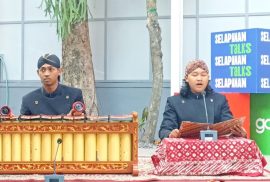
Students of the Javanese Language, Literature, and Culture Program Present Sekar Dhandhanggula at Selapanan Talk#1 Pusaka Jawa UGM
College StudentNews Friday, 29 September 2023
Yogyakarta - On Friday (09/10/2023), two students from the Javanese Language, Literature, and Culture Program, namely Rafael Raga B. P. and Affan Akbar, performed the Macapat song sekar Dhandhanggula in the Selapanan Talk event organized by Pusat Kajian Jawa (the Center for Javanese Studies) or Pusaka Jawa UGM.
The Sekar Dhandhanggula sung by Rafael Raga B.P. is the 13th stanza from Serat Jampi Susah written by R. Pujaarja in 1918. The performance was accompanied by the gender musical instrument played by Affan Akbar, using the Slendro Pathet Sanga tuning. Here is an excerpt from Sekar Dhandhanggula in Serat Jampi Susah stanza 13:
Rèhning kabèh ihtiyaring jalmi
Ora kêna lamun dèn têtêpna
Kang têtêp amung kodraté
Pêrlu apa dèn ulur
Iku kêna kinarya mirit
Marang waris kang waras
Aja mèlu-mèlu
Anglalu luru sangsara
Saranané mung narima jroning ati
Ing mêngko arêp apa
After the performance, Rafael Raga B.P. explained the meaning contained in the song. He stated, "In this song, R. Pujaarja expresses his view that regardless of the results and predetermined fate, effort remains important in one's self-development and providing wisdom to others. The perspective on destiny is crucial because the weight of problems and difficulties in life can be overcome with a narima (Receiving) attitude."
Furthermore, he added, "R. Pujaarja then emphasizes a question, 'ing mêngko arêp apa?' (what will you do in the future?), which invites us to reflect and introspect while moving forward towards the future. With such an attitude, it is hoped that the Javanese community can nurture their mental health to achieve a good ultimate goal, which is khusnul khotimah (a good end of life), bali marang sangkan paaraning dumaid (returning to the Creator.)"
The Selapanan Talk event is a routine activity held every 35 days. On this occasion, the theme discussed was "Javanese-Style Mental Health," and it invited two main speakers, Rudy Wiratama, S.I.P., M.A., a lecturer from the Javanese Language, Literature, and Culture Program at UGM, and Salma Dias Saraswati, CEO and Co-Founder of Tenang. This event serves as an important platform for discussing and understanding Javanese values in giving meaning to the soul and its application to mental health issues, especially among today's younger generation.


First Gathering of Javanese Language, Literature, and Culture Students A.Y. 2022-2023
College StudentNewsStudent's Activity Friday, 29 September 2023
Yogyakarta - The Javanese Language, Literature, and Culture Program successfully organized the "First Gathering" event for students of the academic years 2022-2023 on Saturday, August 26, 2023. The warmly held event took place in Room 303, 3rd floor of the Margono Building. The hosts for this occasion were Yudha Adistira and Nabila Purwaningtyas, both of whom are students from the 2022 cohort.
The activity commenced with an opening by the hosts, followed by a speech from Imam Prakoso, S.S., M.A., a lecturer from the Javanese Language, Literature, and Culture Program. He also serves as the mentor of the Javanese Literature Student Association (HMJ KAMASTAWA).

Imam Prakoso, S.S., M.A., gave opening speeches
Subsequently, the event continued with the "nglaras memitran" session. During this session, students from the 2022 and 2023 cohorts had the opportunity to get to know each other. The hosts made this session more engaging by dividing participants into small groups. Each group member had to remember the names of all their group members. For those who couldn't mention their friends' names, a light penalty was imposed as part of the interaction.
The "nglaras memitran" session unfolded in an atmosphere of joyfulness. The session concluded without any participants receiving penalties, reflecting the spirit of getting acquainted and interacting regardless of seniority or juniority.

Getting to know each other in the "nglaras memitran" session
Next came the "kado silang" session, in which students from the 2023 cohort brought wrapped food items as gifts and then distributed them randomly. Afterward, the students were given the chance to enjoy the food they had received.
Following that was the "ke-HMJ-an" segment presented by Adjit Royan Mustafa Ganda Sukma, Chairman of HMJ KAMASTAWA, part of the Candrabirawa cabinet. In this session, students from the 2023 cohort were introduced to and provided with an explanation of HMJ KAMASTAWA.

Adjit Royan Mustafa Ganda Sukma as the chairman of HMJ KAMASTAWA explained the material about HMJ KAMASTAWA
Equally important was the "tataning bebuden" session presented by R. Putra Sukaca, Taruna Dharma Jati, and Sindi Virnanda. They elaborated on etiquette in the context of academics, including communication with lecturers, speaking, dressing, and other aspects. Despite addressing serious issues, their delivery was engaging, relaxed, and easily comprehensible to students from the 2023 cohort. This session also included humor, making it warmer and eliciting laughter.

R. Putra Sukaca (left), Sindi Virninda (center), dan Taruma Dharma Jati (right) explain ethics in lectures
Upon completing the "tataning bebuden" session, the "First Gathering" event for Javanese Language, Literature, and Culture students of the academic year 2022-2023 was concluded by the hosts. Subsequently, a documentation session was held to capture the moments of togetherness.
This "First Gathering" served as a platform for students of the 2022-2023 cohort to get to know each other and strengthen their relationships. Through the "ke-HMJ-an" and "tataning bebuden" sessions, it is hoped that students of the 2023 cohort will gain a better understanding of the self-development platform provided by HMJ KAMASTAWA and grasp the essential ethical values for their academic journey ahead

Yogyakarta - On Tuesday (22/08/2023), the Javanese Language, Literature, and Culture Program from the Faculty of Cultural Sciences (FIB) at Universitas Gadjah Mada (UGM) successfully organized a seminar titled "How to 'Sell' Yourself: Personal Branding for Entering the Workforce." The event took place in the Soegondo Auditorium, 7th floor of FIB UGM, and was attended by students from the Javanese Language, Literature, and Culture Program of the academic years 2021, 2022, and 2023. The seminar featured Imam Prakoso, S.S., M.A., a lecturer from the Javanese Language, Literature, and Culture Program at UGM, as the moderator.
The main speaker of the seminar was Giok Kinski Maharani Detri Ayusta, the recipient of the title Princess Indonesia Intelegensia 1 2023 and Princess Indonesia 2023 number 07. She is also an alumnus of the undergraduate and graduate programs at the Faculty of Law, UGM. Her participation in the United Nations program to promote, train, and study Human Rights (HR) reflects her social commitment. In this seminar, Giok Kinski Maharani Detri Ayusta shared her career journey experiences and guided students on maintaining enthusiasm in pursuing their aspirations.
Giok Kinski Maharani Detri Ayusta offered several valuable tips, including setting priorities in the activities undertaken, taking full responsibility for each task, building a wide social network, and addressing feelings of insecurity by viewing them as challenges that can be overcome.

(Giok Kinski Maharani Detri Ayusta is answering a question from one of the participants)
Following the presentation by Giok Kinski Maharani Detri Ayusta, the question and answer session was opened by the moderator. High participation was evident from the enthusiastic engagement of participants who actively posed questions to the speaker.
This seminar is expected to provide participants with the motivation to apply insights about personal branding to optimize their potentials. Dr. Sulistyowati, M.Hum., a representative of the chairperson of the Javanese Language, Literature, and Culture Program, expressed her hopes in her address, "Our friends here possess a foundation and a wealth of knowledge rooted in culture. This can serve as an asset when presenting something and carrying the mission of Indonesia to the world. We are rooted in culture, as Indonesia and Universitas Gadjah Mada possess cultural richness and local wisdom, enabling us to be deeply rooted, rise high, and bear abundant fruits. The cultural assets we have and the tools provided by Ms. Giok can ignite the spark for our friends to further optimize themselves."
HMJ KAMASTAWA Holds Event ‘Javanese Literature Sharing and Teaching’ at Al Wahhaab Orphanage
College StudentNewsStudent's Activity Tuesday, 26 September 2023
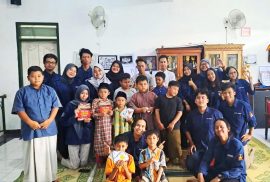
On Sunday (13/08/2023), the Social Community Division in collaboration with the Scholarly Division of the Student Association of the Department of Javanese Literature (HMJ KAMASTAWA) successfully organized the event 'Javanese Literature Sharing and Teaching.' This program resulted from the collaborative initiative of the Social Community Division and the Scholarly Division.
The Javanese Literature Sharing and Teaching event took place at the Al-Wahhaab Sinar Melati 11 orphanage, located at Jl. Wijaya Kusuma Gg. Arjuna No. RT. 01/14, Dero, Condongcatur, Depok district, Sleman Regency, Special Region of Yogyakarta. A total of 10 children of various age groups, ranging from toddlers to first-year junior high school students, participated in this activity.
The event commenced with an introduction session between the participants and the orphanage children, followed by interactive lessons in writing and reading using flashcards. This series of learning was followed by a quiz session involving the use of these flashcards. Subsequently, the atmosphere became more enjoyable with games and singing traditional Javanese children's songs together.
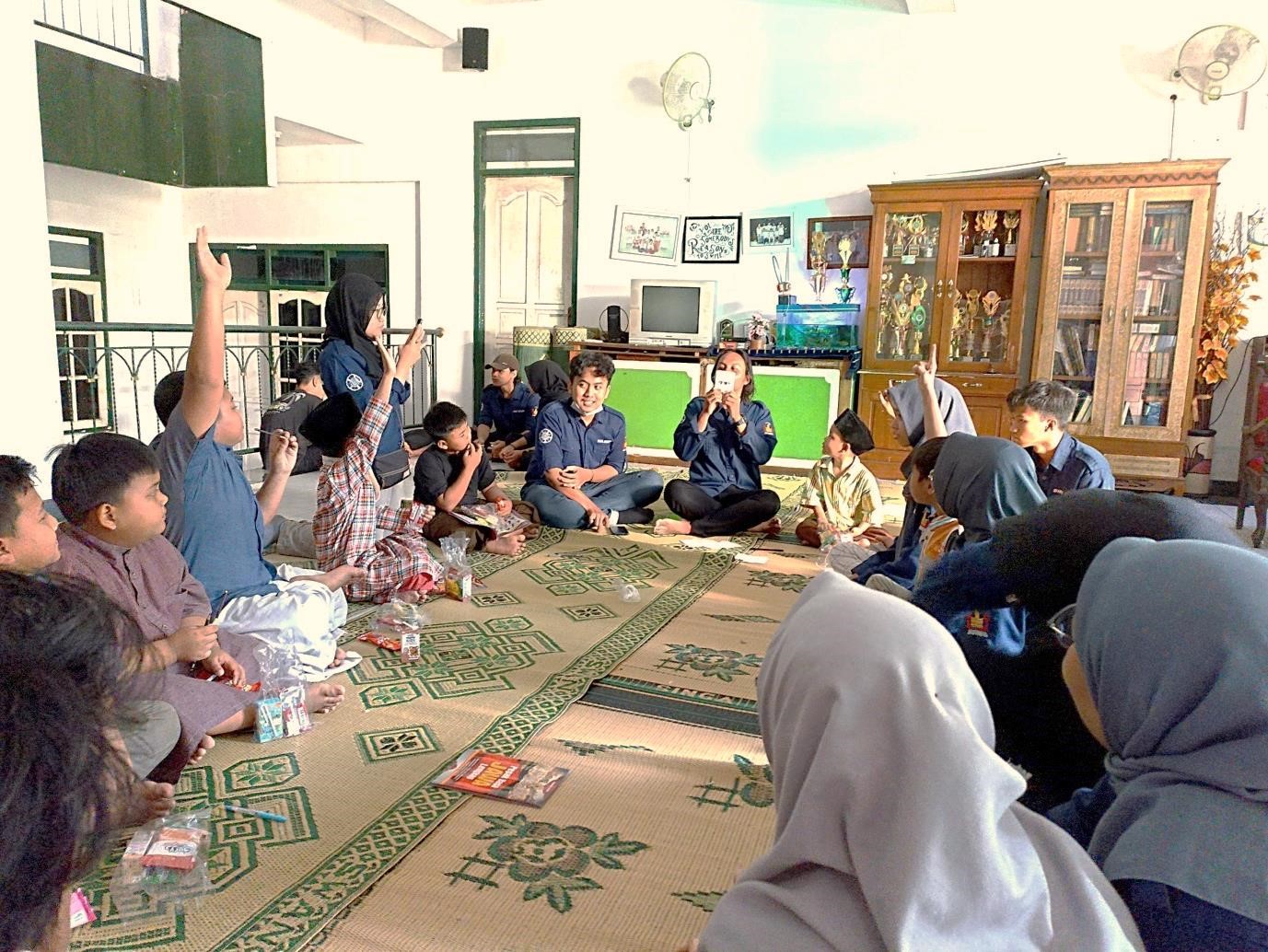
Puzzle game by guessing the names of objects in Javanese language
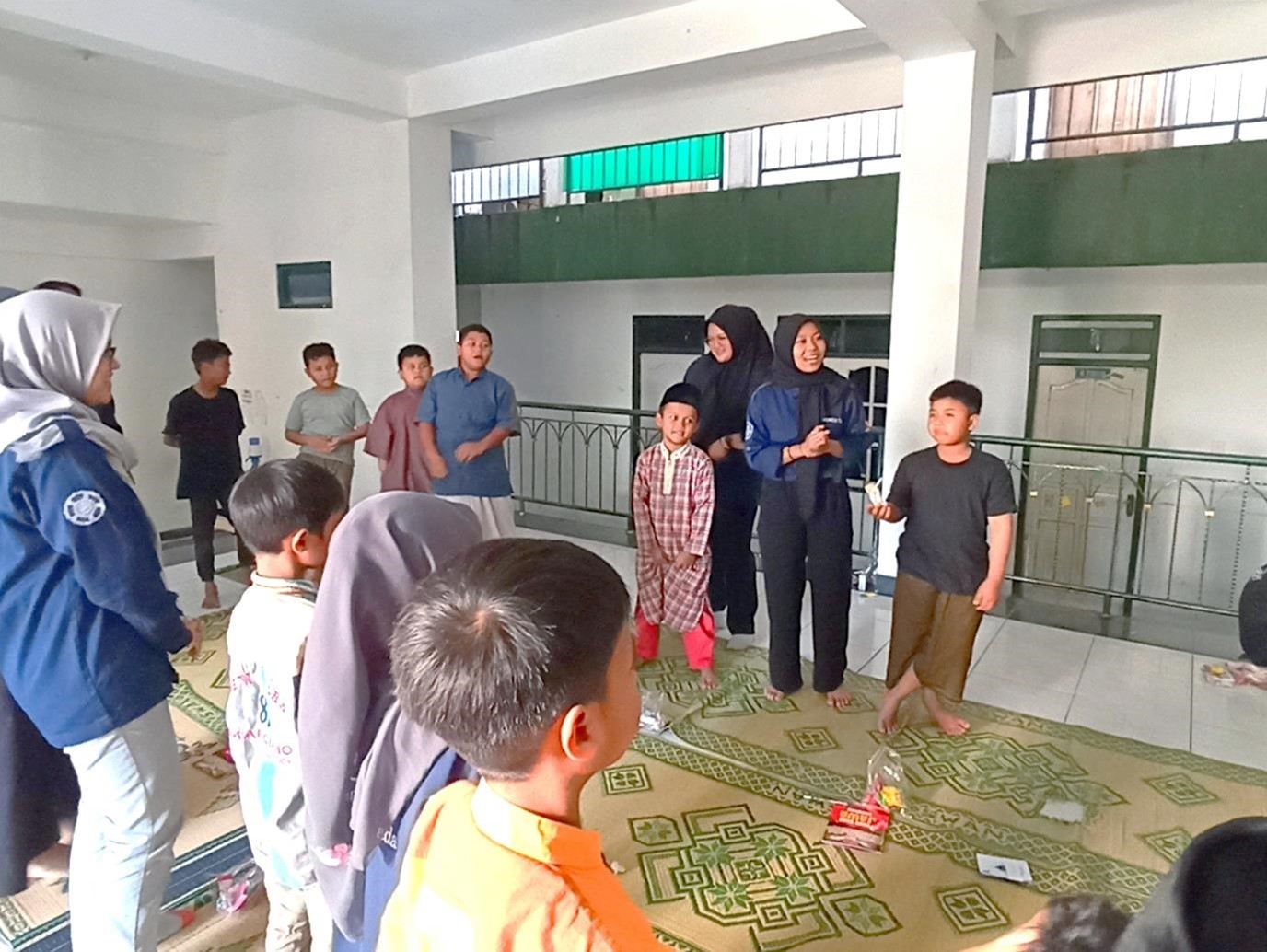
Play and sing the traditional Javanese children's songs together
The enthusiasm displayed by the children was palpable, from the beginning to the end of the event, especially during the awarding of small prizes as tokens of appreciation for their participation in the flashcard quiz. In addition to the prizes, HMJ KAMASTAWA also provided Javanese language guidebooks (pepak basa Jawa) as an effort to introduce and cultivate an interest in Javanese culture among the children in the orphanage.
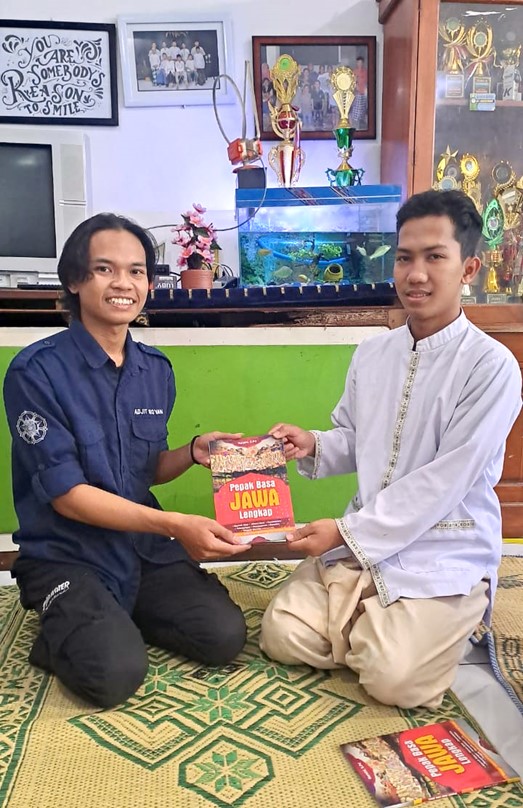
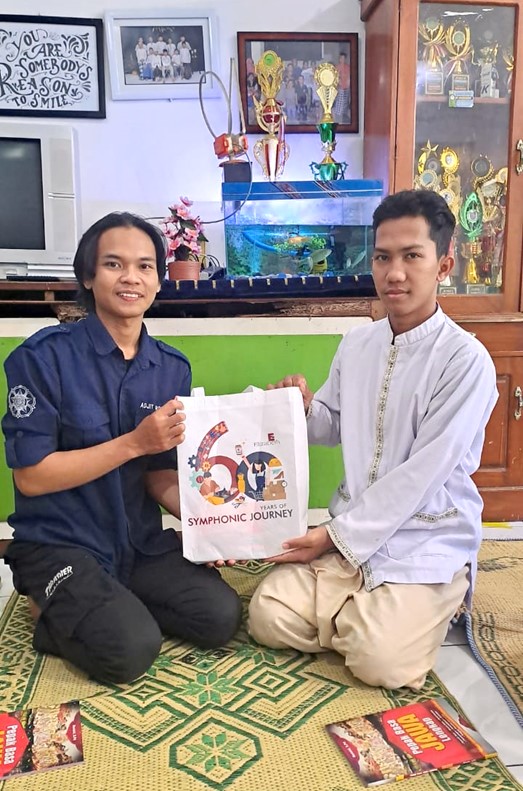
Handover of mementos from HMJ KAMASTAWA to the Al-Wahhaab Orphanage.
Though the contributions made might be modest, the significant hopes and sincere intentions to share and impart knowledge about Javanese literature consistently underpinned every step of the 'Javanese Literature Sharing and Teaching' program carried out by HMJ KAMASTAWA. This program provides a valuable experience in bridging the academic world with society, supporting cultural and literary development among children.
Faculty of Cultural Sciences’ PPSMB Kampung Budaya 2023: Introducing the Faculty Environment at Universitas Gadjah Mada
College StudentNewsSDGSStudentStudent's ActivityStudent's Work Tuesday, 26 September 2023
Source : PPSMB Kampung Budaya UGM (July, 17, 2023). Jingle PPSMB Kampung Budaya 2023 [Video]. YouTube, https://www.youtube.com/watch?v=WLcA9_ZvIB4
Yogyakarta - The Successful Learner Training for New Students (PPSMB) of the Faculty of Cultural Sciences (FIB) was held from August 2nd to August 3rd, 2023. The Faculty's PPSMB is named "Cultural Village" (Kampung Budaya). The Cultural Village 2023 embraced the theme of "Amerta Grantha," which signifies the eternal binding ties. This theme was chosen as a reflection of the reality within Universitas Gadjah Mada, particularly within the diverse backgrounds of the Faculty of Cultural Sciences. This diversity is analogized as a thread that is interwoven into a common purpose or a large umbrella of unity, namely the Faculty of Cultural Sciences (FIB).
The commencement of the Cultural Village 2023 on the first day started at 06:00 AM with a warm welcome. The new students gathered in their respective "padukuhans" (clusters) along Sosio Humaniora Street. The names of these "padukuhans" were derived from various batik patterns found in Indonesia. After gathering, at 07:30 AM, the students entered the Faculty of Cultural Sciences through the northern gate. Upon entering the Greenland area, they were welcomed by the melodious tunes of the "gamelan" ensemble, Gamasutra. Subsequently, speeches were delivered by the coordinator of the cultural village, the President of the Faculty's Student Executive Board (LEM), and Prof. Dr. Setiadi, S.Sos., M.Si., the Dean of the FCS UGM.
The role of the master of ceremony (MC) during the Cultural Village 2023 was taken by Rafael Raga, a student of the Javanese Language, Literature, and Culture Program, and Putri Diah Syafitri, a student of the Indonesian Language and Literature Program.
The event continued with a traditional dance performance by Sasoebah accompanied by Gamasutra's "gamelan," followed by the screening of alumni videos, and subsequently a cultural lecture by Prof. Dr. Setiadi, S.Sos., M.Si. Prof. Dr. Setiadi, S.Sos., M.Si. elaborated on the diversity of Indonesia and how this diversity should be perceived in the present context.
Afterward, the event proceeded with a modern dance performance by Sasoebah, followed by an alumni introduction session. The alumni introduction was a dialogue session with alumni from the Faculty of Cultural Sciences. Among the attending alumni were Mr. Paksi Raras Alit, S.S., M.A., an alumnus of Nusantara Literature (currently Bahasa, Sastra, dan Budaya Jawa), and Ms. Hesti, S.S., M.B.A., an alumnus of Japanese Language and Culture. In this session, the new students gained insights and an understanding of career prospects after completing their education in FIB.
The event continued with the screening of the Cultural Village jingle, followed by introductions to TU (Technical Unit) and PK4L (Occupational Safety and Health and Environmental Safety Center). The event proceeded with the introduction to PKM (Student Creativity Week), followed by the screening of alumni videos once more. Subsequently, the organizers directed the students to engage in ISHOMA (Rest, Eat, and Gather) activities. The event concluded with a bonding session aimed at fostering connections among the students within their respective "padukuhan."
On the second day, specifically on August 3, 2023, at 06:30 AM, the "Sapa Mahadya" session was held on Sosio Humaniora Street. The students gathered according to their chosen study programs. At 07:30 AM, the students then engaged in the study program session.
The study program session for the Javanese Language, Literature, and Culture Program was held in the Siti Baroroh Building, 2nd floor. The session was carried out warmly, allowing the students to become acquainted with the intricacies and nuances of the program, as well as gain insights into its prospects.
At 09:00 AM, the students regrouped within their respective "padukuhan" and visited various Semi-Autonomous Body (BSO) stations. This activity lasted until noon, followed by a break (ISHOMA) until 01:00 PM.
The event continued with the screening of the Cultural Village jingle, followed by traditional dance performances by BSO Rampoe and Buchaechum by students of the Korean Language and Culture Program. Then, a Ketoprak performance by Sastra Conthong brought laughter to the students.
The event proceeded with awarding nominations for the most spirited team, the most agile team, the most cohesive team, and the best batik creations. Subsequently, the MC concluded the Cultural Village 2023 activities.
However, this did not signify the end of the Cultural Village 2023. The event continued with a flash mob performance by the Cultural Village 2023 organizers and a performance by the Kombantrin band. Kombantrin performed several songs, including "Seandainya" by Vierra and "Pamer Bojo" by the late Didi Kempot. The supporter's performance concluded the Cultural Village event. With the beat of drums and the waving of supporter flags, the students and organizers sang together, and the supporters guided the students back to the northern gate of the FIB.
The Cultural Village 2023 New Student Orientation was executed successfully and with great enthusiasm. Thus, it is hoped that the Cultural Village 2023 New Student Orientation will provide a comprehensive understanding of the academic environment for the students and ignite their passion to engage dynamically within the Faculty of Cultural Sciences at UGM. May the new students achieve success throughout their academic journey at FIB UGM and in their future endeavors.
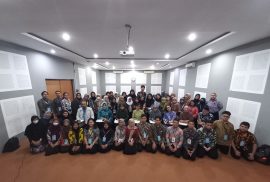
Study Program Orientation Session: Introducing and Bonding New Students class of 2023 Javanese Language, Literature, and Culture Study Program
College StudentNewsSDGSStudentStudent's Activity Monday, 25 September 2023
Thursday (08/03/2023) – The study program orientation session as a part of the Successful Learner Training for New Students (PPSMB) of the Cultural Village (Kampung Budaya) 2023 Faculty has been successfully conducted with great warmth. The study program orientation session is an activity carried out to acquaint the students with the intricacies and nuances of the chosen study program, allowing them to dynamically engage in their future pursuits.
The Javanese Language, Literature, and Culture Study Program held its study program orientation session at the Siti Baroroh Building, 2nd floor. This session was not only attended by students and faculty members but also by KAMASTAWA, the organization representing the Student Program Association (HMJ) under the auspices of the Study Program.
The master of ceremony (MC) for the session was Nurma Aisyah (class of 2021) and Saktia Hidayah (class of 2022). Before the commencement of the study program orientation session, the MC introduced the lectures of the Javanese Language, Literature, and Culture Study Program, along with a brief overview of the HMJ KAMASTAWA. Thanks to their efforts, the session unfolded in a warm atmosphere, alleviating any initial unease among the students.
The event began with an opening address by Dr. Daru Winarti, M.Hum., the head of the Javanese Language, Literature, and Culture Study Program. She elaborated on the details and various aspects of the study program, introducing lecturers, study program administration, and fields of study (Linguistics, Philology, and Literature), offering advice for successful coursework, announcing student allocation to Academic Supervisors ((DPA), and providing insights into post-graduation prospects.
Following this, the session progressed with further presentations by the lecturers specializing in their respective study fields. The field of philology was presented by Dr. Arsanti Wulandari, M.Hum., and Dr. Sri Ratna Saktimulya, M.Hum. The field of literature was elucidated by Dra. Wiwien Widyawati Rahayu, M.A., Rudy Wiratama, S.I.P., M.A., and R. Bima Slamet Raharja, S.S., M.A. For the field of linguistics, Imam Prakoso, S.S., M.Hum., provided the insights. After the presentations on the study fields, Nurmalia Habibah, S.S., M.A., presented the curriculum that the students would undertake.
On this occasion, Dr. Daru Winarti, M.Hum., shared an inspiring message with the students, "If you choose this field (Javanese Language, Literature, and Culture), it will open up numerous opportunities for you to achieve great things." She emphasized.
By conducting the study program orientation session, it is expected that the students will gain comprehensive knowledge about the study program they have chosen to engage in. Furthermore, they will have the chance to become familiar with the faculty members who will be instructing them and establish connections with their senior peers.