May
Prof. Dr. Hendrokumoro, M.Hum.: Express Yourself, but Stay Njawani ‘Rooted in Javanese Values’
College StudentNewsSDGSStudentStudent's ActivityStudent's Work Friday, 22 May 2026
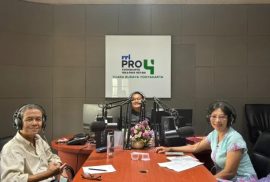
Prof. Dr. Hendrokumoro, M.Hum., during the Kawruh broadcast on Pro 4 Radio Republik Indonesia Yogyakarta. From Gen Z Expresses Modernity while Remaining Grounded and Njawani [Photo], by Titik Renggani, 2026, rri.co.id. Fully cited from: https://rri.co.id/yogyakarta/budaya/2433916/gen-z-berekspresi-modern-namun-tetap-membumi-dan-njawani.
The rapid flow of global culture has made today’s younger generation vulnerable to being swept along and potentially losing their identity. To address this challenge, locally grounded character education is considered an important foundation for preserving identity while shaping strong personal character. This issue was discussed by Prof. Dr. Hendrokumoro, M.Hum., a lecturer in the Javanese Language, Literature, and Culture Study Program, Faculty of Cultural Sciences, Universitas Gadjah Mada, during the Kawruh broadcast on Pro 4 Radio Republik Indonesia Yogyakarta on Friday, May 22, 2026, from 09:00 to 10:00 WIB. The broadcast carried the theme “Slay tapi Njawani: Manifesto Pendidikan Karakter Berbasis Lokal di Hari Kebangkitan Nasional [Slay but Njawani: A Manifesto of Locally-Based Character Education on National Awakening Day]” in commemoration of National Awakening Day (Renggani, 2026).
In his presentation, Prof. Dr. Hendrokumoro, M.Hum., explained that modernity is not something to be rejected. Young people are encouraged to express themselves while still holding firmly to Javanese cultural values, or njawani. These values are reflected in attitudes such as andhap asor (humility), avoiding arrogance, and upholding ethical behavior.
He also emphasized that preserving culture does not mean abandoning progress. On the contrary, local wisdom can go hand in hand with modernity. In the context of language, for instance, although language continues to evolve dynamically, young people still need to understand the concept of empan papan, which means using language appropriately according to the situation and context.
Furthermore, he highlighted that instilling ethical and moral values cannot be achieved solely through a blame-oriented approach. The process must involve listening, guiding, and positioning things proportionally. In this regard, the role of parents is crucial as role models, as expressed in the Javanese principle ing ngarsa sung tuladha, ing madya mangun karsa, tut wuri handayani, “those in front set an example, those in the middle build initiative, and those behind provide encouragement.”
This discussion is expected to broaden public understanding of the importance of maintaining a balance between culture and modern progress. Culture does not need to be abandoned for the sake of modernity; rather, it should be harmonized to remain relevant in contemporary life.
In addition, this activity aligns with the Sustainable Development Goals (SDGs), particularly SDG 4 on quality education through the dissemination of knowledge to the public. It also supports SDG 17 on partnerships by emphasizing the importance of collaboration among educational institutions, cultural institutions, and society in preserving the cultural heritage of the Indonesian archipelago, especially Javanese culture.
Bibliography
Renggani, T. (2026, 23 Mei). Gen Z Berekspresi Modern namun Tetap Membumi dan Njawani [Foto]. rri.co.id. Diakses pada 24 Mei 2026, dari https://rri.co.id/yogyakarta/budaya/2433916/gen-z-berekspresi-modern-namun-tetap-membumi-dan-njawani.
List of Figures
Renggani, T. (2026, May 23). Gen Z Expresses Modernity While Remaining Grounded and Njawani [Photo]. rri.co.id. Fully cited from https://rri.co.id/yogyakarta/budaya/2433916/gen-z-berekspresi-modern-namun-tetap-membumi-dan-njawani.
Author : Haryo Untoro
Editor : Haryo Untoro


Cipta Karya Sastra Jawa: A Creative Space for Students to Learn and Develop Literary Works
College StudentNewsSDGSStudentStudent's ActivityStudent's Work Thursday, 21 May 2026
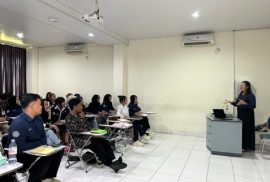
In an effort to improve students’ writing skills, particularly in the field of Javanese literature, the Javanese Language, Literature, and Culture Study Program Universitas Gadjah Mada organized a teaching practitioner activity themed Javanese Literary Creation. The activity was held in Margono Room 404, Faculty of Cultural Sciences, Universitas Gadjah Mada as part of the Productive Written Javanese course on April 14 and 21, 2026.
The activity featured Sri Suryani as the teaching practitioner, guiding students to become more familiar with the world of Javanese literary writing. This class formed part of the Productive Written Javanese course for the 2026 academic year, taught by Dr. Sulistyowati, M.Hum.
During the first meeting on April 14, 2026, students received material on modern Javanese literary works and creative writing techniques, particularly short stories (cerkak). In addition to the presentation session, students and the teaching practitioner discussed the planned outputs of the activity, namely an anthology of cerkak and geguritan. Students were also given the opportunity to submit their written works, which would later be discussed in the following session.
Meanwhile, during the second meeting on April 21, 2026, students studied geguritan with a focus on stylistic elements. The activity then continued with a discussion of the works submitted in the previous meeting. Students presented drafts of their writing and discussed them with the teaching practitioner and fellow participants. The discussion session was lively and interactive, as students not only learned how to write, but also gained an understanding of the processes of developing, editing, and preparing literary works for publication.
The teaching practitioner activity was carried out smoothly and successfully, supported by the strong enthusiasm of students from the Javanese Language, Literature, and Culture Study Program in learning about Javanese literary writing. Through this activity, students not only gained an understanding of the creative process of literary writing, but also acquired practical experience in developing their works more thoroughly. The outputs of the activity, in the form of Javanese literary works such as cerkak and geguritan, are expected to serve as learning media as well as a means for younger generations to foster love and pride for Indonesian culture, particularly Javanese culture. In addition, this activity aligns with the goals of the Sustainable Development Goals (SDGs), especially SDG 4 on quality education through the strengthening of students’ literacy and creativity competencies, and SDG 17 on partnerships for the goals through collaboration between academics and practitioners in developing experience-based learning.
Author : Haryo Untoro
Editor : Haryo Untoro
The Javanese Language, Literature, and Culture Study Program, FIB UGM, Graduated 11 Students in the 2025/2026 Academic Period III Graduation Ceremony
College StudentNewsSDGSStudentStudent's Work Thursday, 21 May 2026
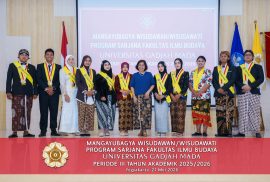
Thursday, (6/21/2026), was a joyful day for the entire family of the Javanese Language, Literature, and Culture Study Program. During the Undergraduate and Applied Undergraduate Graduation Ceremony for Academic Year 2025/2026 Period III, a total of 11 students were officially declared graduates and successfully completed their studies at the Faculty of Cultural Sciences, Universitas Gadjah Mada. The students who attended the graduation ceremony were:
- Agnes Anggito Sekar Laras
- Azaliya Khoirunnisa
- Dewi Halimatus Solikhah N
- Endar Sasmito Aji
- Haryo Untoro
- Jifani Wahyu Anggra Rani
- Muhammad Siswoyo
- Novia Hikmatul Mubarokah
- Rizqy Salsabila Ratna Purwadi
- Septi Indah Lestari
- Yosafat Dimas Rangga Adigama
This graduation ceremony also became a source of pride for the Javanese Language, Literature, and Culture Study Program. During the Mangayubagya Wisudawan/Wisudawati Sarjana Periode III Tahun Akademik 2025/2026 held by the Faculty of Cultural Sciences UGM, the Dean of the Faculty of Cultural Sciences UGM, Prof. Dr. Setiadi, S.Sos., M.Si.,, announced that Novia Hikmatul Mubarokah had achieved the distinction of obtaining the third-highest Grade Point Average (GPA) in the Faculty of Cultural Sciences graduation ceremony for this period.
This graduation marks the beginning of the graduates’ journey and dedication to society. The spirit and hard work demonstrated throughout their years of study are expected to serve as valuable provisions in facing both professional and academic endeavors in the future.
This graduation marks the beginning of a new journey for the graduates after completing their years of study. The knowledge, experiences, and spirit they have developed are expected to serve as a strong foundation in facing both professional life and their role in society. The graduates are also expected to continue preserving, safeguarding, and developing the cultural heritage of the Indonesian archipelago, especially Javanese culture, so that it may remain alive and beneficial to society as well as contribute to the progress of the nation.
Author : Haryo Untoro
Editor : Haryo Untoro
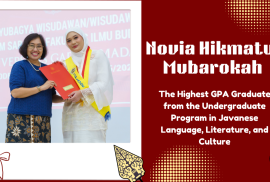
Novia Hikmatul Mubarokah, the Highest GPA Graduate from the Undergraduate Program in Javanese Language, Literature, and Culture
College StudentNewsSDGSStudentStudent's ActivityStudent's Work Wednesday, 20 May 2026
The Faculty of Cultural Sciences at Universitas Gadjah Mada (FIB UGM) held the graduation ceremony for undergraduate and applied undergraduate programs for Period III of the 2025/2026 Academic Year. In this period, the Undergraduate Program in Javanese Language, Literature, and Culture graduated 11 students. In his remarks, the Dean of FIB UGM, Prof. Dr. Setiadi, S.Sos., M.Hum., stated that the majority of students with the highest grade point averages (GPA) came from the Arabic Literature Program. Nevertheless, there was one female student from the Undergraduate Program in Javanese Language, Literature, and Culture who succeeded in achieving the highest GPA at this graduation ceremony. The student was Novia Hikmatul Mubarokah with a GPA of 3.91. This achievement became a source of pride as well as an inspiration for students, especially within the Undergraduate Program in Javanese Language, Literature, and Culture.
On May 26, 2026, an online interview was conducted with Novia regarding her academic journey. In achieving the high GPA, Novia revealed that she always tried to actively learn from various sources. “Learning is not merely from textbooks, but from various sources. In addition, exchanging ideas with friends from different academic years, lecturers, and even people outside the study program is also necessary to broaden our insights,” she explained. According to her, such a learning method makes the learning process feel not merely like an obligation, but rather a space to grow and develop.
Not only active in academics, Novia was also involved in various organizational activities and part-time work. She admitted to being active in several student organizations and working at Arnawa journal publishing as an editorial staff member. “I am also active in various organizations and work part-time at Arnawa journal publishing as an editorial staff member,” she said.
Behind her academic achievement, Novia also faced various challenges during her years of study. She stated that the first and fourth semesters were the most difficult periods in her studies. “The first semester was a time for me to adapt, especially because my background was not closely related to exposure to Javanese cultural knowledge. This was what motivated me to put in extra effort. Then, the fourth semester or second year became a busy year with a denser class schedule, because there were compulsory university courses and I also became part of the Daily Executive Board of the Student Association of the Undergraduate Program in Javanese Language, Literature, and Culture (HMJ Kamastawa),” she explained. However, from the various challenges, Novia felt that her time management skills became increasingly well honed.
In her undergraduate studies, Novia took a concentration in philology, a field of study that examines the language, culture, and history of a nation through ancient manuscripts. Interestingly, she chose a privately owned or non-institutional manuscript collection as the object of her research, rather than collections from libraries or certain institutions. “I chose the Layang Ambiya manuscript from a non-institutional collection as my research object. This is interesting because of the massive ‘Ambiya’ corpus in Javanese literature, while research on the manuscript is still limited. The stories contained in the Ambiya manuscript are very interesting to study further because they are rich in insights into Islam according to the Javanese people of that time,” she revealed.
When asked about her feelings after successfully achieving the highest GPA, Novia admitted that she felt proud and grateful for the results she obtained. For her, the achievement could not be separated from her family’s support. “My greatest motivation is to make my family proud because they have trusted me to pursue education away from home. Even though I have achieved the best result, there is still a feeling that I should not be easily satisfied because there will be many things that need to be learned,” she said. According to her, GPA is only one provision for moving on to the next stage of life.
At the end of the interview, Novia also conveyed a message for students of the Undergraduate Program in Javanese Language, Literature, and Culture to continue enjoying the process during their studies. She also emphasized the importance of not hesitating to ask for help when experiencing difficulties. “Consult your academic advisor and/or thesis supervisor if you feel you need a discussion partner. Besides that, do not hesitate to ask your friends for help. They will be very helpful,” was her message.
In particular, Novia also gave a message to students pursuing the field of philology, especially those researching non-institutional manuscript collections. “In my opinion, when conducting research on manuscripts from non-institutional collections, we need to ask the owners a lot about their knowledge of the manuscript, not merely ask for permission to conduct research. This is to understand the role of the manuscript in the life of the community. Such efforts are important to preserve the values contained in the manuscript text,” she added.
Novia Hikmatul Mubarokah’s journey during her studies in the Undergraduate Program in Javanese Language, Literature, and Culture shows that every process has its own challenges and stories. Amid academic activities, organizations, and part-time work, she continued trying to carry out everything diligently and enthusiastically. The highest GPA she achieved was not merely a number, but the result of a long process, the support of those closest to her, and the willingness to keep learning. It is hoped that Novia’s story can become an encouragement for other students to continue trusting the process they are going through and not be afraid to keep developing.
Author : Haryo Untoro
Editor : Haryo Untoro
Setu Sinau: Revitalizing Javanese Script within Society
College StudentNewsSDGSStudentStudent's ActivityStudent's Work Monday, 18 May 2026
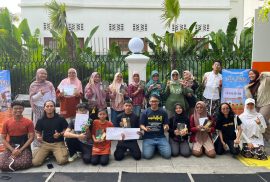
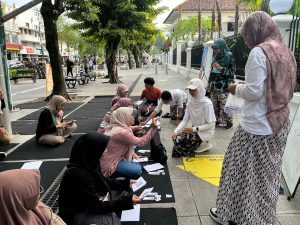
The Javanese Language, Literature, and Culture Study Program of the Faculty of Cultural Sciences at Universitas Gadjah Mada (FIB UGM), in collaboration with the Yogyakarta City Culture Office, organized an activity entitled Setu Sinau on Saturday (16/05/2026). The activity took place along the Malioboro corridor from 07.00–09.00 WIB as an effort to reintroduce Javanese script to the wider community, particularly the younger generation.
The selection of the Malioboro area as the location of the activity was not without reason. As one of the most iconic public spaces in Yogyakarta, Malioboro serves as a strategic place to present cultural learning directly within society. Its open and lively atmosphere enabled the activity to reach participants from various backgrounds, ranging from children to adults.
The implementation of Setu Sinau was motivated by the growing distance between the younger generation and Javanese script due to the currents of globalization and modernization. Through this activity, Javanese script was introduced not only as a cultural heritage, but also as part of an identity that needs to be preserved and passed on. The collaboration with the Yogyakarta City Culture Office became a tangible form of synergy between educational institutions and the government in supporting the implementation of the Yogyakarta Special Region Regulation related to the preservation of Javanese language, literature, and script.
The activity featured two lecturers from the Javanese Language, Literature, and Culture Study Program as instructors, namely Dr. Arsanti Wulandari, M.Hum. and Zakariya Pamuji Aminullah, S.S., M.A., who specialize in the field of philology. In addition, students from the Javanese Language, Literature, and Culture Study Program also served as facilitators, namely Ghibran Arsha Daffa’ Musaffa’, Bayu Seta Ardiansyah, Dian Patmisari, and Maysa Putri Fatihah.
The learning process was designed in an enjoyable and interactive manner. Participants were invited to learn Javanese script through media such as flashcards, educational posters, as well as direct practice in writing and pronouncing Javanese script. This approach enabled participants not only to understand the theory, but also to experience the learning process directly through simple practice.
The learning method applied was aligned with the value contained in pupuh Pocung stanza 33 by KGPAA Sri Mangkunegara IV, namely ngelmu iku kalakone kanthi laku, which means “knowledge is realized through action.” Through direct practice, participants were encouraged to understand that learning culture is not sufficient merely by knowing it, but also needs to be practiced and habituated in everyday life.
The implementation of Setu Sinau was also in line with the objectives of the Sustainable Development Goals (SDGs), particularly point 4 on quality education, point 11 on sustainable cities and communities, and point 17 regarding partnerships for achieving the goals. By presenting cultural learning in a public space, this activity became a small yet meaningful step in preserving the continuity of Javanese script amid the development of the times.
Author : Haryo Untoro
Editor : Haryo Untoro