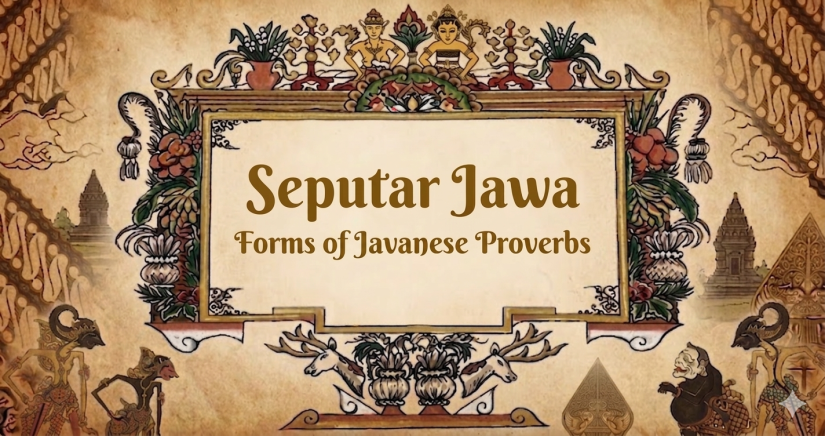
Indonesians often use proverbs or idioms when communicating. One example is the frequent use of the Malay idiom “tak kenal maka tak sayang” to lighten the mood in various formal and informal settings. However, upon closer examination, Javanese culture also has idioms and proverbs that are worth exploring. In his dissertation, Hendrokumoro (2016) explains that Javanese culture has eight types of proverbs, including paribasan, bêbasan, saloka, pêpindhan, sanepa, panyandra, isbat, and sêmboyan.
The first form described is the paribasan. Technically, paribasan is a grammatical unit with a fixed structure that is straightforward and does not contain a metaphor, yet carries a figurative meaning (Padmosoektojo, 1958). One example is the expression ana catur mungkur, which literally means “there is talk of leaving.” The meaning behind this expression is the wise attitude of someone who refuses to pay attention to gossip or negative talk from others (Padmosoektojo, 1958:62).
Furthermore, there is a Javanese proverb known as bebasan.” Bebasan is a proverb with a fixed form, figurative meaning, and emphasizes the metaphorical description of a person’s condition or behavior (Padmosoekotjo, 1958). An example is wis kêbak sundukane “the pricks are already full”, indicating that the person in question has committed many mistakes. This metaphor originates from the culture of elders or leaders in the past who used to insert pins to record the mistakes of their subordinates. If the pins were full, it meant that the person had committed far too many mistakes (Padmosoektojo, 1958:62).
The next category is saloka, Javanese proverbs that take the form of fixed phrases and share similarities in both usage and meaning (Padmosoekotjo, 1958). The primary focus is on the subject or person; what is being likened is a person, a trait, or a situation, using metaphors involving animals or objects (Padmosoekotjo, 1958; Subalidinata, 1968; Dirdjosiswojo, 1956). An example of a saloka is asu bêlang kalung wang ‘a spotted dog wearing a money necklace’, which depicts the common people or the lower class possessing abundant wealth (Padmosoekotjo, 1958:76).
Additionally, there are pêpindhan that function as instruments of comparison. Unlike other forms, pêpindhan often use comparative terms such as lir, pindha, kaya, or their synonyms to equate objects with humans (Padmosoekotjo, 1958; Hadiwidjana, 1967). For example, the expression kuning pindha mas sinangling ‘yellow like gold that has been polished’ is used to describe a yellow color that shimmers beautifully, much like gold that has been polished. Furthermore, sangling itself is a tool used for polishing gold (Padmosoekotjo, 1958: 95).
The next category is sanepa. Sanepa is a metaphor whose meaning actually conveys the opposite or a negation (Subalidinata, 1968). The expression suwe banyu sinaring—“water takes a long time to filter”—for example, is actually used to describe someone who responds very quickly to something (Hendrokumoro, 2016).
Javanese proverbs also employ aesthetic or beautiful forms in the sense of panyandra or candra. Panyandra or candra is used to describe physical beauty as a form of impressive praise (Padmosoekotjo, 1958; Hendrokumoro, 2016). One form of bodily beauty often praised is drijine mucuk eri, which describes fingers as beautiful as thorn tips, characterized by fingertips that are smaller than the base of the finger (Hendrokumoro, 2016).
Another form of Javanese proverb is called Isbat. The form of isbat is similar to saloka, whose content or intended meaning relates to metaphysical, philosophical, or occult dimensions containing spiritual messages (Widati et al., 2015; Subalidinata, 1968). The expression golek gêni adêdamar ‘searching for fire while carrying a lamp’ serves as a philosophical metaphor suggesting that in the pursuit of true knowledge, one requires a foundation of knowledge to serve as a guide (Widati et al., 2015).
Finally, as a source of inspiration, the term sêmboyan refers to a set of phrases designed to foster optimism and guide action (Hendrokumoro, 2016). The legendary motto rawe-rawe rantas, malang-malang putung—“swinging objects are struck down, obstructing objects are severed”—reflects an unyielding determination to overcome all obstacles in order to achieve the desired goal (Hendrokumoro, 2016:92).
Bibilography
Dirdjosiswojo. (1956). Paribasan. Jogjakarta: Kalimosodo.
Hendrokumoro. (2016). Peribahasa dalam Bahasa Jawa. Disertasi. Yogyakarta: Program Pascasarjana, Fakultas Ilmu Budaya, Universitas Gadjah Mada.
Padmosoekotjo, S. (1958). Ngengrengan Kasusastraan Djawa I: Kanggo Para Siswa Sekolah Guru lan Sekolah Landjutan Lijane. Jogjakarta: Hien Hoo Sing.
Subalidinata, R.S. (1968). Sarining Kasusastraan Djawa. Jogjakarta: Jaker.
Widati, S., Rahayu, P., dan Prabowo, D.P. (2015). Ensiklopedi Sastra Jawa. Yogyakarta: Kementerian Pendisikan dan Kebudayaan, Balai Bahasa Provinsi Daerah Istimewa Yogyakarta
Author: Haryo Untoro
Editor : Haryo Untoro, Nurul Fajri Rahmani