• University
  • Academic Portal
  • University Library
  • Webmail
  • Arnawa
  • UM UGM
  • English
    • Bahasa Indonesia
    • English
Universitas Gadjah Mada Javanese Language, Literature, and Culture Program
Department of Language and Literature
Faculty of Cultural Sciences
Universitas Gadjah Mada
  • Home
  • Profile
    • Vision & Mission
    • Objective
    • Excellence
    • Career Prospects
    • Teaching Staff
  • Academic
    • Curriculum Flow
    • Courses Description
    • Distribution of Courses
    • Academic Calendar
    • COURSE AND ADMINISTRATION INFORMATION
    • Learning Outcomes
    • INTERNATIONAL CONFERENCES AND ACTIVITIES
  • KPPB
    • Collaboration
    • Research
      • Teaching Staff Research
      • Javanese Studies Archive – Arnawa
    • Service
      • Community Services
      • Podcast (Anarka Lālitya)
    • Scholarship
  • Student Affair
    • Student Satisfaction Survey
    • HMJ Kamastawa
    • Student’s Activity
    • Student’s Creations
    • Youtube Channel
    • Instagram
  • Alumnus
    • Alumnus Profile
  • Contact
  • Home
  • UGM
  • UGM
  • page. 4
Arsip:

UGM

Inaugural Speech of Prof. Dr. Hendrokumoro, M.Hum. as Professor of Linguistics at Faculty of Cultural Sciences UGM

NewsSDGS Thursday, 8 May 2025

Qouted in full from: https://fib.ugm.ac.id/2025/05/pengukuhan-prof-dr-hendrokumoro-m-hum-sebagai-guru-besar-bidang-ilmu-linguistik-fakultas-ilmu-budaya-ugm.html

A solemn atmosphere enveloped the Senate Hall, Central Building of Universitas Gadjah Mada (UGM) on Thursday (8/5/2025), when the Faculty of Cultural Sciences UGM inaugurated Prof. Dr. Hendrokumoro, M.Hum. as Professor of Linguistics. This inauguration became a historic moment for the Javanese Language, Literature, and Culture Study Program of the Faculty, which was also proud of the achievement of one of its best lecturers. read more

Exploring the Ins and Outs of Codicology Through Field Lectures

College StudentNewsSDGSStudent Tuesday, 6 May 2025

With the aim of improving understanding related to lectures, the lecturer of codicology, Dr. Sri Ratna Saktimulya, M.Hum. brought Javanese Language, Literature, and Culture students of the 2023 class to visit three libraries; the Widyabudaya Keraton Ngayogyakarta library, the Sonobudoyo Museum library, and the Widyapustaka Pura Pakualaman library.

This field lecture started in the morning at 08.30 until the afternoon at 15.00. Students were asked to gather in the parking lot of the Keraton Ngayogyakarta Hadiningrat before 08.30 for joint preparation and direction. The first destination visited was the Widyabudaya library. There, students were invited and accompanied by abdi dalem to look around and get to know the rooms in the library such as the reservation room, archive room, depo-archive room. In addition, students were also given manuscripts to observe their physical condition according to the material that had been taught such as the paper material, the illumination contained in the manuscript, and others. read more

Dare to Create: A Strategic Step to Preserve and Develop Javanese Literature for the Young Generation

NewsSDGSStudentStudent's Activity Monday, 5 May 2025

The fate of a culture, including its language and literature, ultimately rests in the hands of its people. Acknowledging this, the Study Program of Javanese Language, Literature, and Culture, Faculty of Cultural Sciences, Universitas Gadjah Mada (FIB UGM), held a special event on Wednesday, April 30, 2025, featuring Drs. Suhartoyo, a passionate advocate and observer of Javanese literature and culture. Drs. Suhartoyo, himself an alumnus of the program, actively manages Majalah Belik, a Javanese-language magazine, and is involved in the Javanese Literature and Culture Association (Paguyuban Sastra dan Budaya Jawa, Pasbuja) Kawi Merapi. read more

Lecturer from UGM’s Javanese Language, Literature, and Culture Program Explores Prince Diponegoro’s Story in the Babad Ngayogyakarta During the First Nusantara Manuscript Literacy Class

NewsSDGS Friday, 2 May 2025

On Tuesday (March 25, 2025), Dr. Arsanti Wulandari, M.Hum., a lecturer from the Javanese Language, Literature, and Culture Program at the Faculty of Cultural Sciences, Universitas Gadjah Mada (FIB UGM), discussed the life of Prince Diponegoro as depicted in the Babad Ngayogyakarta during the first session of the Nusantara Manuscript Literacy Class. The event was organized by the Center for Library Information Services and Nusantara Manuscript Management (Pujaasintara) of the National Library of the Republic of Indonesia (Perpusnas RI), under the theme “Another Side of Diponegoro: The Prince from Two Perspectives.” read more

Schedule of Prof. Dr. Hendrokumoro’s Inaugural Speech, M.Hum.

NewsSDGS Thursday, 1 May 2025

Universitas Gadjah Mada (UGM) is pleased to announce an important event: the inaugural professorial lecture of Prof. Dr. Hendrokumoro, M. Hum., from the Study Program of Javanese Language, Literature, and Culture, Faculty of Cultural Sciences. The event will take place on Thursday, May 8, 2025, from 09:00 to 10:00 AM WIB, at the Senate Hall, UGM Main Building.

On this occasion, Prof. Hendrokumoro will deliver a lecture titled “Eksistensi Bahasa Jawa Saat Ini beserta Peran, Tantangan, dan Peluangnya” (The Current Existence of the Javanese Language: Its Roles, Challenges, and Opportunities). This topic is expected to provide profound insights into the present condition of the Javanese language amidst ongoing social and cultural shifts, including its strategic role in society as well as the challenges and opportunities that lie ahead. For members of the public who wish to follow the event, UGM will provide a live broadcast via the official Universitas Gadjah Mada YouTube channel, accessible through this link read more

Lajang Watjan: Enriching the Treasures of Javanese Literature

College StudentNewsSDGSStudentStudent's ActivityStudent's Work Tuesday, 22 April 2025

As part of the assignment for the Javanese Literature Treasury course taught by Mrs. Dra. Wiwien Widyawati Rahayu, M.A., Javanese Language, Literature, and Culture students from the class of 2024 visited the Lajang Watjan (re: Layang Wacan) exhibition located at Bentara Budaya Yogyakarta. This assignment began with a group assignment. The groups that were formed departed individually, because there were still 2 days left of the exhibition, namely the 18th and 19th.

In the exhibition, what students observed were various books and manuscripts. After observing, students chose one material object to reveal its contents. One of them is Babad Pagedongan. In addition to revealing the contents of the book or manuscript, there was also a 1-minute short video assignment as proof that students had visited the exhibition. In addition to books, there were old manuscripts displayed on the walls and could not be touched because of their age. However, there were still many new manuscripts placed on the exhibition table and could be read. read more

Visiting the Yogyakarta Archives Diorama: Very Informative!

College StudentNewsSDGSStudentStudent's Activity Thursday, 17 April 2025

Tuesday, April 15, 2025, in order to fulfill the mid-term exam assignment for the Productive Written Javanese Language course taught by Mas Imam Prakoso, students of Language, Literature, and Culture class of 2024 visited the Jogja Archives Diorama. The Jogja Archives Diorama is located at Jl. Janti No.Lt. 1, Banguntapan District, Bantul Regency, Special Region of Yogyakarta.

The Jogja Archives Diorama displays archives that have a long historical connection from the land of Yogyakarta, namely from the era of Panembahan Senopati to the present day. The archives on display are of various forms, from those in textual form, photographs, audiovisuals, and others. These archives are managed and exhibited with the aim that the general public can learn lessons related to the history of the Special Region of Yogyakarta. read more

Sosmas Berbagi 2025: Blessings in the Month of Ramadan

College StudentNewsSDGSStudentStudent's Activity Wednesday, 2 April 2025

Towards the end of the last Ramadan, the social division of HMJ KAMASTAWA carried out an annual work program, namely Sosmas Berbagi. Sosmas Berbagi is an annual agenda of the social division of society which is generally carried out in the month of Ramadan every year, namely the distribution of alms to people in need in the form of consumption for breaking the fast.

This year, Sosmas Berbagi was held on Saturday, March 22, 2025. Together with members of the social division of society and representatives from other divisions, they left campus and went around Kotabaru and Gejayan. From the funds collected amounting to one million rupiah, the social division distributed it in the form of heavy meals, namely fried chicken rice and iced tea. read more

Lecturer of Javanese Language, Literature, and Culture Study Program Introduces Philology in Public Lecture: Philology in Javanese Manuscript Studies

NewsSDGS Friday, 31 January 2025

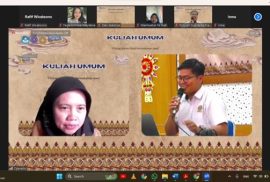
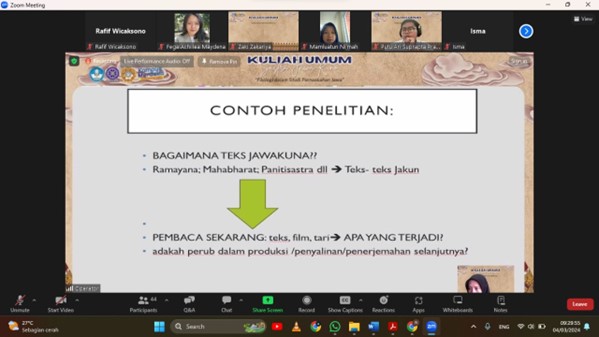
On Monday, March 4, 2024, at 09.30 WITA, Dr. Arsanti Wulandari, S.S., M.Hum, a lecturer from the Javanese Language, Literature and Culture Study Program, became a speaker in a public lecture entitled ‘Philology in Javanese Manuscript Studies’. This activity was held through the Zoom Meeting platform and initiated by the Javanese Literature Study Program, Faculty of Cultural Sciences, Udayana University (FIB UNUD).

In the public lecture, Dr. Arsanti Wulandari presented an introduction to philology, reviewed the concept of philology, the object of study, the tasks of philologists, and the final product produced. The presentation was equipped with examples of Javanese manuscripts and their identification, so that the audience could understand about philology more easily. The discussion session that followed provided space for participants to ask various questions, showing their high enthusiasm for the topics discussed.


Kuliah umum mengenai filologi ini diadakan sebagai respons terhadap semakin berkurangnya minat mahasiswa dalam bidang studi filologi. Meskipun demikian, saat ini pemerintah sedang serius mendorong penggalian pengetahuan dan nilai-nilai yang terkandung dalam naskah kuno. Harapannya, melalui kegiatan semacam ini, minat, dan pemahaman terhadap filologi dapat tumbuh kembali di kalangan mahasiswa.

Pentingnya memahami dan menjaga keberlanjutan pengetahuan serta nilai-nilai kebudayaan yang terdapat dalam naskah kuno menjadi fokus kuliah umum ini. Dengan memberikan bekal pengetahuan, semangat, dan menjalin kerja sama yang baik, diharapkan pengetahuan dan nilai-nilai kebudayaan pada naskah kuno dapat tetap lestari dan dapat kemudian dikembangkan sesuai dengan kebutuhan zaman. Hal ini selaras dengan tujuan pembangunan berkelanjutan, terutama dalam meningkatkan mutu pendidikan (poin 4) dan memperkuat kerja sama untuk mencapai tujuan bersama (poin 17).


Seputar Jawa: Records of Disease Outbreaks and Cure Methods in Javanese Written Literature

NewsSDGS Wednesday, 18 September 2024

Quoted in full from: cebu.fkkmk.ugm.ac.id

Recently, the World Health Organization (WHO) declared Monkeypox a global health emergency. The disease, which was first transmitted to humans in 1970 in the Republic of Congo, has been detected in Indonesia, and as of August 17, 2024, there were 88 confirmed cases (Rokom, 2024).  This incident reminds us of the COVID-19 pandemic that hit the world in 2020.

The history of disease outbreaks is not new. The Asian Flu (1957-1958), Spanish Flu (1918-1920), and The Black Death (1346-1353) (Kautsar, 2024), are just some examples of major outbreaks that have hit the world. In addition to major epidemics, various small endemics also often occur in certain regions.

Various disease outbreaks have been recorded in manuscripts and written records. Taruna Dharma Jati, Muhammad Ibu Prarista, Zalsabila Purnama, & Zakariya Pamuji Aminullah (2022) in a scientific article entitled Lawe Wĕnang Singid: The Red Thread of Pagĕblug Handling Continuity in the Perspective of Javanese Literature explains that Javanese written literature has contained information in the form of traces and handling of physical and cosmological plagues in Javanese oral and written literature.

Some manuscripts that contain information on the physical treatment of disease outbreaks include Naskah Ngelmu Kawarasan by Sardjita (1920), Naskah Lĕlĕmbut Kolerah by Samsimihardja (1914), and Naskah Lĕlara Gudhig by Sardjita (1921). These texts provide guidance on the prevention and treatment of various diseases that once plagued society in their day.

  • Manuscript of Ngelmu Kawarasan

The Ngelmu Kawarasan manuscript contains knowledge about diseases such as malaria, smallpox, bubonic plague, and tuberculosis. One part of the manuscript explains how to deal with bubonic plague:


[...] Rekadaya kangge nanggulangi pes, botĕn wontĕn malih kajawi tikus-tikus punika kĕdah dipuntumpĕs. Griya-griya ingkang kĕrĕp dipunrĕsiki. Sarta sampun nyimpĕni sisa tedha

“There is nothing more effective against bubonic plague than culling rats, cleaning houses frequently, and not storing leftover food.”

This guide shows the importance of environmental hygiene as a preventive measure against infectious diseases such as bubonic plague, which is transmitted by rats.

  • Manuscript of Lĕlĕmbut Kolerah

The Lĕlĕmbut Kolerah manuscript focuses on ways to avoid cholera. Here is one of the contents of the manuscript:

[...] Prentah nagara dikon ngombe banyu bening wedang ora kĕna mamangan kang ora matĕng, ora kalawan diratĕngi adus ing bangawan.

“The state commandment says to drink boiled water, not to eat raw food, and to bathe frequently in the river.”

Here, there is an emphasis on drinking boiled water and personal hygiene as preventive measures.

  • Manuscript of Lĕlara Gudhig 

The Lĕlara Gudhig manuscript explains how to prevent and cure gudik (gudhig), a contagious skin disease. One of the quotes from this manuscript states:

[...] Supaya wong sing wis waras iku ora kumat maneh. Yen panyegahe lalara gudhig iku arĕp ditindakake supaya wong-wong bumi liya-liyane padha bisa milu. Dheweke kudu dipĕrdi rĕsikan, yaiku: ngrĕksa rĕsiking kulite ing panggonan-panggonan sing pĕrlu. Sedhiyan banyu adus kudu dibecikake. Sarta kudu ambudidaya supaya rĕgane sabun dimurah bangĕt, nganti wong miskin padha kelar sabunan. Wong-wong mau ditĕrangake sing tĕmĕnan, yen ora mung awake bae sing mesthi rĕsikan nanging sandhangan lan paturone uga mangkonoa. [...]

“So that people who are already healthy from scabies do not relapse, prevention of scabies should be carried out so that people in other areas can follow each other. They should be accustomed to clean living, keeping their skin and other places clean. Good water should be provided for bathing, and efforts should be made to reduce the price of soap so that the poor can use it. These people are to be explained seriously, that not only the self must be clean but also the clothes and bedding as well. [...]”

This message highlights the importance of personal hygiene with access to hygiene tools, such as soap, as well as ensuring that clothes and bedding are clean, to prevent skin diseases.

The above are just a few of the various explanations of plague prevention in Javanese literature. Although it can be said to be old stuff, the principles contained are still relevant today, especially in the context of preventing disease outbreaks that are transmitted through unsanitary environments.

Further exploration of ancient Javanese manuscripts is an important step to broaden our horizons on the history of health and medicine in Indonesia. Collaboration between academics, philologists, and health practitioners can help develop the knowledge recorded in these manuscripts, so that it can benefit the wider community.


BIBLIOGRAPHY

Bestari, N.P. (2022, July 24). ). Sejarah Perjalanan Cacar Monyet dari Afrika sampai Mendunia. Cnbcindonesia.com. Accessed from https://www.cnbcindonesia.com/news/20220724153248-4-358100/sejarah-perjalanan-cacar-monyet-dari-afrika-sampai-mendunia.


Jati, T.D., Prarista, M.I., Purnama, Z. & Aminullah, Z.P. (2022). Lawe Wĕnang Singid: Benang Merah Kontinuitas Penanganan Pagĕblug dalam Perspektif Kesusastraan Jawa. Jumantara: Jurnal Manuskrip Nusantara,  13(01), 95-112, from https://doi.org/10.37014/jumantara.v13i1.2847.


Rokom. (2024, August 18). 88 88 Kasus Konfirmasi Mpox di Indonesia, Seksual Sesama Jenis jadi Salah Satu Penyebab. Sehatnegeriku.kemkes.go.id., Accessed from https://sehatnegeriku.kemkes.go.id/baca/rilis-media/20240818/1546252/88-kasus-konfirmasi-mpox-di-indonesia-seksual-sesama-jenis-jadi-salah-satu-penyebab/.

LIST OF IMAGES

Cebu.fkkmk.ugm.ac.id. (2020, August 19). ). CE&BU Bersama PKMK dan Cochrane Indonesia Menyelenggarakan Webinar Mengenai Bukti Ilmiah tentang Penanganan Wabah Pandemik COVID-19. Retrieved from https://cebu.fkkmk.ugm.ac.id/2020/08/19/cebu-bersama-pkmk-dan-cochrane-indonesia-menyelenggarakan-webinar-mengenai-bukti-ilmiah-tentang-penanganan-wabah-pandemik-covid-19/


123456…9

Recent Post

  • Seputar Jawa: Banten Javanese Dialect, a Dialect that Exists at the Westernmost of Javanese Island
    March 10, 2026
  • Graduating in 3.5 Years: The Strategy of Three Students from the Javanese Language, Literature, and Culture Study Program at UGM in Completing Their Studies
    March 2, 2026
  • Seputar Jawa: Basa Kedhaton and Basa Bagongan, Typical Speech Varieties of the Surakarta and Yogyakarta Palaces
    March 2, 2026
  • Three Students from the Javanese Language, Literature, and Culture Study Program Successfully Graduated in 3.5 Years
    February 26, 2026
  • Handover of HMJ Kamastawa Positions for the 2026/2027 Period
    February 24, 2026

Calender

April 2026
M T W T F S S
 12345
6789101112
13141516171819
20212223242526
27282930  
« Mar    
  • Fakultas Ilmu Budaya
  • Ujian Masuk UGM
  • PPSMB
  • Alumni
  • Jurnal Humaniora
April 2026
M T W T F S S
 12345
6789101112
13141516171819
20212223242526
27282930  
« Mar    

News

  • Seputar Jawa: Banten Javanese Dialect, a Dialect that Exists at the Westernmost of Javanese Island
    March 10, 2026
  • Graduating in 3.5 Years: The Strategy of Three Students from the Javanese Language, Literature, and Culture Study Program at UGM in Completing Their Studies
    March 2, 2026
  • Seputar Jawa: Basa Kedhaton and Basa Bagongan, Typical Speech Varieties of the Surakarta and Yogyakarta Palaces
    March 2, 2026
Universitas Gadjah Mada

Javanese Language, Literature, and Culture Program
Department of Language and Literature
Faculty of Cultural Sciences
Universitas Gadjah Mada


Sosiohumaniora St., Bulaksumur, Yogyakarta
Telp : 0274-901134 Ext. 110, Fax : 0274-550451, WhatsApp : 081211911281
Email : nusantara@ugm.ac.id

© 2025 Javanese Language, Literature, and Culture Program FIB UGM

KEBIJAKAN PRIVASI/PRIVACY POLICY