• University
  • Academic Portal
  • University Library
  • Webmail
  • Arnawa
  • UM UGM
  • English
    • Bahasa Indonesia
    • English
Universitas Gadjah Mada Javanese Language, Literature, and Culture Program
Department of Language and Literature
Faculty of Cultural Sciences
Universitas Gadjah Mada
  • Home
  • Profile
    • Vision & Mission
    • Objective
    • Excellence
    • Career Prospects
    • Teaching Staff
  • Academic
    • Curriculum Flow
    • Courses Description
    • Distribution of Courses
    • Academic Calendar
    • COURSE AND ADMINISTRATION INFORMATION
    • Learning Outcomes
    • INTERNATIONAL CONFERENCES AND ACTIVITIES
  • KPPB
    • Collaboration
    • Research
      • Teaching Staff Research
      • Javanese Studies Archive – Arnawa
    • Service
      • Community Services
      • Podcast (Anarka Lālitya)
    • Scholarship
  • Student Affair
    • Student Satisfaction Survey
    • HMJ Kamastawa
    • Student’s Activity
    • Student’s Creations
    • Youtube Channel
    • Instagram
  • Alumnus
    • Alumnus Profile
  • Contact
  • Home
  • SDGS
  • page. 17
Arsip:

SDGS

Gugur Gunung 11 Webinar: History, Function, and Existence of Javanese Fables

Ambal WarsaCollege StudentNewsSDGSStudent Thursday, 14 September 2023

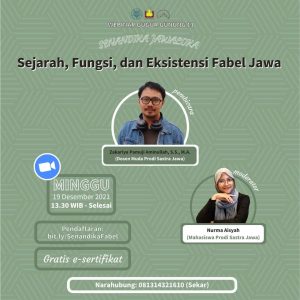
On Sunday (December 19, 2021), the Javanese Literature Program held the second webinar as a continuation of a series of events. The webinar titled "History, Function, and Existence of Javanese Fables" was moderated by Nurma Aisyah, a student of the Javanese Literature Program from class of 2021, and accompanied by one of the Javanese Literature lecturers, Zakariya Pamuji Aminullah, S.S., M.A., as the speaker.

The "History, Function, and Existence of Javanese Fables" webinar delved into the journey of birds and monkeys from the Sanskrit tradition to the Middle Javanese era. Mr. Zakariya presented that fables are stories about animals that behave like humans. The story of animals made like humans is a metaphorical depiction. Fables predominantly feature characters that are either human or deities. Usually, the animal characters used in fables play crucial roles in society, such as cows, horses, snakes, goats, birds, and others. The webinar also discussed the Pancatantra, a literary work that takes the form of framed stories.
After the presentation session, the webinar proceeded with a Q&A session. There were eight questioners, each with one question. One of the interesting questions, which might also be a common inquiry from the public, came from Irfan Wahyu, a Javanese Literature student. Irfan asked about the popularity of fables, specifically those involving the character "kancil" (mouse deer), and why fables are mainly targeted at children. Mr. Zakariya explained that Indonesian education has not adapted to fables effectively. Some efforts have been made by libraries to implement the transliteration of manuscripts, and academic communities are encouraged to disseminate these transliterations to the wider public. From the perspective of researchers, they face a significant responsibility in transforming the contents of manuscripts into works that can be accessible to the broader society.

The conclusion drawn from the "History, Function, and Existence of Javanese Fables" webinar is that fables serve as a medium between humans and animals. Meanwhile, the Pancatantra has political motives and has spread widely across the world. The popular story of birds and monkeys, despite having various versions, shares a common message.
Cakra Manggala, the New Cabinet of KAMASTAWA

College StudentNewsSDGSStudentStudent's ActivityStudent's Work Thursday, 14 September 2023

The name "Cakra Manggala" has been chosen as the cabinet name by the daily executive board of the Family of Javanese Literature Students (KAMASTAWA) for the period 2022/2023. The name "Cakra Manggala" is derived from "cakra," symbolizing a round-toothed weapon. From "cakra," the daily executive board holds high hopes that the Cakra Manggala cabinet will work diligently and firmly in their respective fields. Additionally, "cakra" can also be interpreted as precision or meticulousness. Through this analogy, the Cakra Manggala cabinet is expected to work with utmost diligence.

On the other hand, "manggala" is inspired by the headgear worn by Sultan Agung. "Manggala" symbolizes blessings and leadership, thereby making this cabinet a symbol of continuous blessings and good fortune and a driving force for Javanese Literature students as a whole. Therefore, with the name "Cakra Manggala," the daily executive board hopes that the Cakra Manggala cabinet will work together with precision and optimal coordination, both in their respective fields and as a whole, while always being filled with blessings and good fortune in every process they undergo.

In this new management, the members of the Cakra Manggala cabinet are active undergraduate students in their second and third years of study. The cabinet consists of 46 members, with one person as the president, one vice chairman, two treasurers, two secretaries, five members in the Human Resources Development division, six members in the Public Relations and Organization division, six members in the Social Community division, four members in the Media and Information division, five members in the Scientific division, five members in the Entrepreneurship and Logistics division, and nine members in the Interest and Talent division.

Through various planned programs and guidance from Mr. Imam Prakoso as the advisor, the daily executive board of KAMASTAWA, in the Cakra Manggala cabinet, aspires to uphold the reputation of Javanese Literature and contribute optimally to the Javanese Literature study program. Moreover, the success of all the planned programs is also dependent on the support of all Javanese Literature students. Thus, the new leadership aims for optimal cooperation so that both the executives and non-executive members can work together to maintain the name of Javanese Literature.

ANJANGSANA of HIMA PBD FBS UNY & HMJ KAMASTAWA FIB UGM: ‘Strengthening Connections and Striving for Organizational Excellence’

College StudentNewsSDGSStudentStudent's Activity Thursday, 14 September 2023

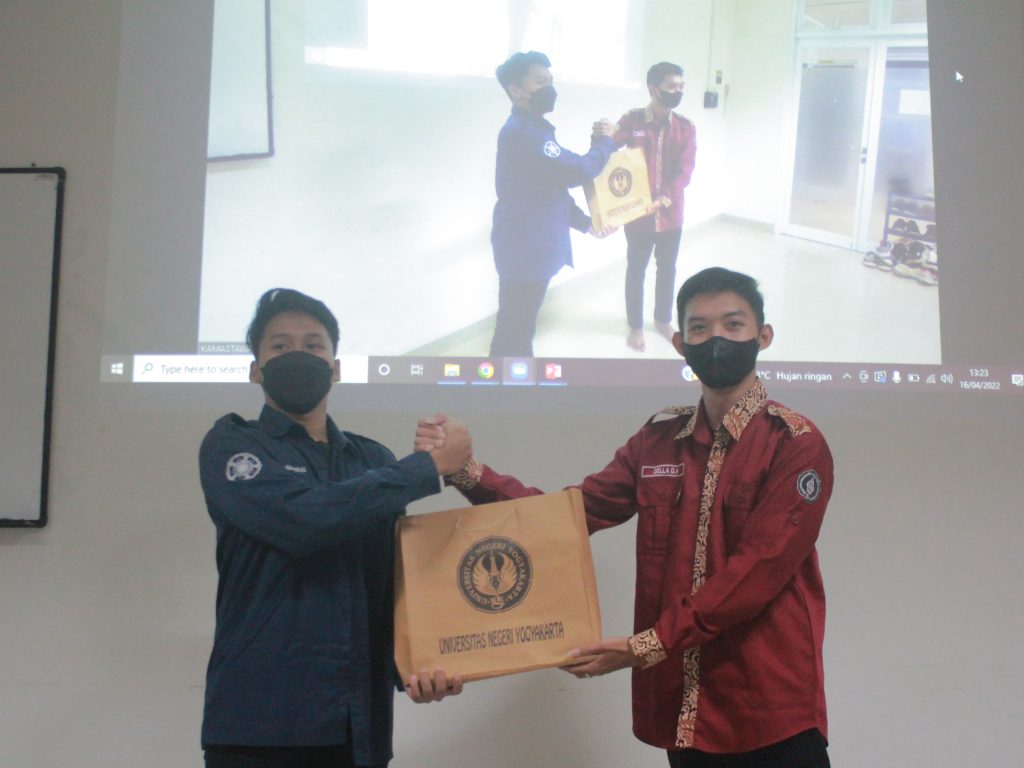
Yogyakarta - The bonding event between the Student Association of Local Language Education, Faculty of Languages and Literatures, Universitas Negeri Yogyakarta (HIMA PBD FBS UNY), and the Student Association of Javanese Literature Department, known as KAMASTAWA, Faculty of Cultural Sciences, Universitas Gadjah Mada (UGM), was warm. The event, which became the work program of the Public Relations and Organisation Division of HMJ Kamastawa, was held on Saturday (16/4) in a mixed manner at Soegondo Building 310.

The event, titled "Anjangsana: Nyambung Silaturahmi saha Ngindhakaken Kualitas Organisasi Tumuju Jinawi," aimed to foster camaraderie between the two associations by exchanging experiences and stories about each student association. HIMA PBD FBS UNY consists of six divisions, namely the Core Daily Board, Public Relations Division, Talent and Interest Division (Bakmi), Spiritual Division, Writing Division, and Welfare Division. Meanwhile, HMJ KAMASTAWA has 8 divisions, namely the Core Daily Board, Human Resources Development Division (PSDM), Public Relations and Organization Division (RPO), Social Community Division (Sosmas), Media and Information Division (Medinfo), Academic Division, Entrepreneurship and Logistics Division (Kewirugistik), and Talent and Interest Division (Mikat), which is further divided into Arts and Sports Sub-Divisions.

The event commenced with an opening, followed by speeches from the event organizer of Anjangsana (Miftahul Jannah), the chairman of HIMA PBD FBS UNY (Helmi Andriansyah), the chairman of KAMASTAWA (Yulian Pamungkas), the head of the PBD FBS UNY program (Dr. Drs. Afendy Widayat, M. Phil.), and the head of the Javanese Literature program (Dr. Daru Winarti, M.Hum.). Subsequently, profiles and work programs of each association were presented, followed by games, sharing of impressions and messages, and finally the closing.

(illustration: Anjangsana Activity)

Through the knowledge shared by each division, both parties had the opportunity to ask questions and evaluate each other's work, albeit limited to certain divisions. After presenting the work programs that would be explored from each association, three programs from KAMASTASWA were selected, namely the Academic Division's Work Program "Dakon: Platform for Aspirations and Consultations," the Talent and Interest Division's Work Program "Ratnatraya," and the Social Community Division's Work Program "Learning Together." Meanwhile, two work programs from the PBD UNY student association were selected for exploration, namely the Writing Division's Work Program "Udyana" and the Talent and Interest Division's Work Program "Collaboration of Three Studio."

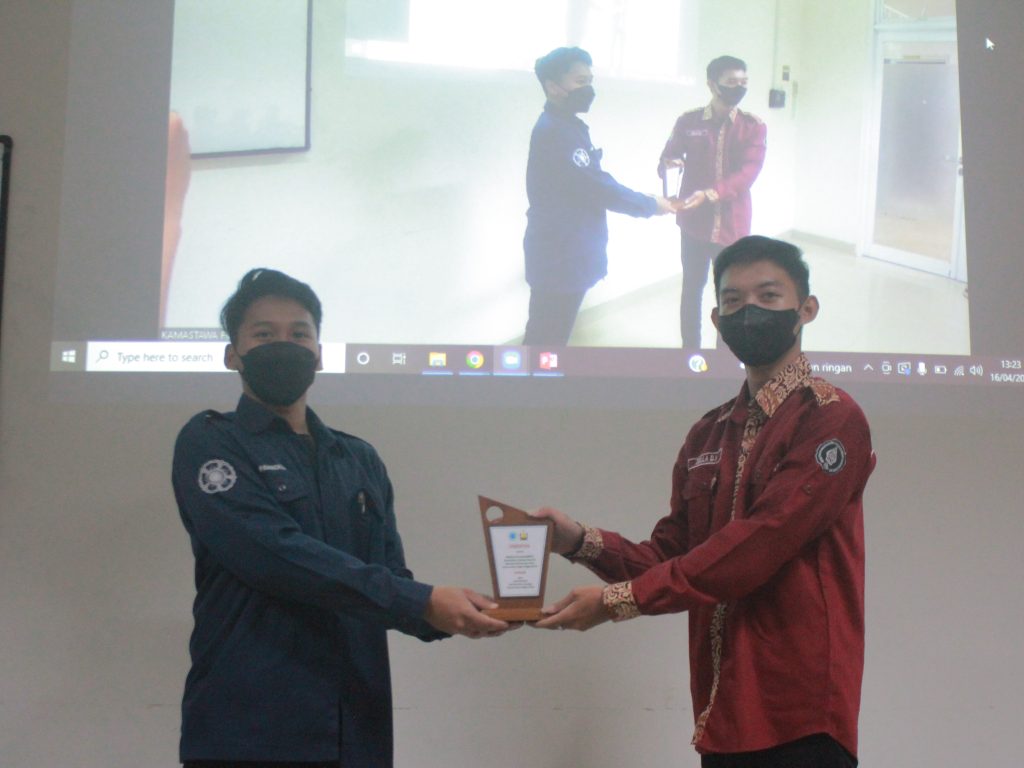
(illustration: Handing of Mementos by the KAMASTAWA Chairman to the HIMA PBD UNY Chairman)

(illustration: Handing of Mementos by the HIMA PBD UNY Chairman to the KAMASTAWA Chairman)

This Anjangsana activity strengthened the relationship between the two student associations. At the end of the event, a memento exchanges and an additional activity of gift exchange were held as a token of appreciation for the successful event.

Kepyakan Kabinet Cakra Manggala

College StudentNewsSDGSStudentStudent's Activity Thursday, 14 September 2023

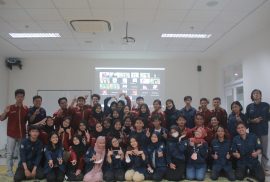
On Sunday (March 6, 2022), the Student Association of Javanese Literature Study Program (HMJ), commonly referred to as KAMASTAWA launched its new cabinet and officially inaugurated the new management members. The event was titled "Kepyakan HMJ KAMASTAWA Cakra Manggala Cabinet" and was conducted virtually using the Zoom platform. The event was attended by Dr. Daru Winarti, M. Hum, the head of the Javanese Literature program, lecturer in Javanese Literature program, the KAMASTAWA chairman of 2020, the KAMASTAWA chairman of 2021, and all the newly appointed daily board members of HMJ KAMASTAWA.

The event was attended by Dr. The host delivered an opening speech, and a prayer followed. Finally, a group photo was taken. Following the speeches by Dr. Daru Winarti, M. Hum., Imam Prakoso, S.S., M.A., and Yulian Pamungkas, the new KAMASTAWA chairman, the grand design and introduction of each division were presented. The event concluded with socializing, another group photo, and closing remarks from the host.

During the launch of the new cabinet, the newly appointed KAMASTAWA chairman presented several aspects, including the cabinet's logo and its philosophy, the action plan, and the cabinet's organizational structure. The newly chosen name for the cabinet of the 2022/2023 term is "Cakra Manggala". Cakra Manggala was selected as the new cabinet's name because the 2022/2023 management aims for significant progress for HMJ KAMASTAWA. The name represents the hope that the members of the Cakra Manggala cabinet will work together meticulously and optimally, both in their respective fields and as a cohesive unit, while always being blessed and fortunate throughout the process.

The new cabinet consists of seven division coordinators who lead their respective divisions, with Yulian Pamungkas as the chairman of the Javanese Literature Class of 2020, and Muhammad Ikhsan from the same class as the vice-chairman. During the cabinet name launch and inauguration of the new management members, the KAMASTAWA chairman gave a speech and expressed hopes that the new cabinet members would collaborate effectively to optimize the implementation of their action plans. Moreover, during the friendly session (consisting of prayers and wishes from faculty members and the previous HMJ chairman), many hopes and prayers were given for the new Cakra Manggala cabinet to process smoothly and for the chosen logo's philosophy to be realized optimally.

Gugur Gunung Webinar 11 “The Tradition of Kidung: History and Uniqueness of Kidung Surajaya”

Ambal WarsaCollege StudentNewsSDGSStudent Thursday, 14 September 2023

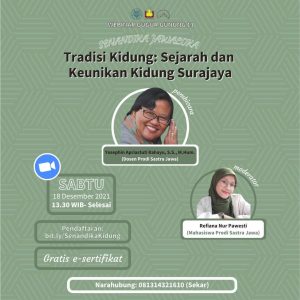
On Saturday, December 18, 2021, the Javanese Literature program held a webinar titled "The Tradition of Kidung: History and Uniqueness of Kidung Surajaya." The webinar was one of two webinars organized to celebrate the anniversary of the Javanese Literature study program. This particular webinar was part of the 11th Gugur Gunung event. The first day of the webinar was moderated by Refiana Nur Pawesti, a Javanese Literature student class of 2020. The presentation was delivered by one of the expert Javanese Literature lecturers, Yosephin Apriastuti Rahayu, S.S., M.Hum.

In the first day's webinar, it was explained that Kidung Surajaya had been previously researched by Ms. Kartika Setyawati, a Javanese Literature lecturer at Universitas Gadjah Mada. The kidung was examined as part of her dissertation. At the beginning of the webinar, Ms. Apriastuti discussed the characteristics of kidung based on Zoetmulder's perspective in Kalangwan. One of Zoetmulder's opinions conveyed by Ms. Apriastuti was that most kidung texts were written in Bali. Zoetmulder also revealed that kidung texts typically contain excerpts of stories.

Ms. Apriastuti explained that Kidung Surajaya is part of the Merapi-Merbabu manuscript collection, which is only found in the National Library of Indonesia. It consists of seven pupuh (a type of poetic meter) with the metrical pattern of macapat. The text was written in the 17th century based on the long version colophon written in Buda script and Mid-Javanese language. Kidung Surajaya has two versions, the long version (D, F, H manuscripts) and the short version (B, E, G, I, J manuscripts). The long version contains around 87 lempir (leaves) with approximately 798 stanzas, while the short version contains 4-14 lempir.

In summary, Kidung Surajaya narrates the journey of Ki Singamada, who is grieving after the passing of his parents. The remarkable aspects of Kidung Surajaya are the advice from the teachers, the protagonist's journey, depictions of nature, the Surajaya initiation ceremony, various flora and fauna, betel leaf, food and drinks served, time indicators, and more. The kidung also provides insights into the agricultural practices of society, the surrounding natural environment, types of flowers, characteristics of women in the past, and much more.

Upon careful observation and analysis, implicit meanings can be found in the names of the characters. For instance, the name Surawani/Surajaya means a brave and victorious person, while the name Hantakarana Ragasamaya means a body that is resilient.

After studying the text, it can be concluded that the purpose of writing Kidung Surajaya was to bring comfort, alleviate sorrow, portray the essence of love, showcase beauty and self-expression, and increase praise. Based on the content and meanings shared, Kidung Surajaya provides many valuable lessons for reflection in life. Its uniqueness and life advice make it worthy of further study and exploration.

Taruna Dharma Jati, the Winner of the Gold Medal in 34th Pimnas Poster Category

College StudentNewsSDGSStudentStudent's ActivityStudent's Work Wednesday, 13 September 2023

Yogyakarta (January 3, 2022) - For a student, achieving remarkable accomplishments is undoubtedly a dream to be realized, especially on a national or even international scale. However, opportunities to achieve such feats may seem challenging at times, be it due to competition or other circumstances.

This is where the story of Taruna Dharma Jati, a student from the Javanese Literature Program at Universitas Gadjah Mada, brings both surprising and joyful news. In 2021, Taruna, along with his team, mentored by Zakariya Pamuji Aminullah, had the opportunity to participate in the Student Creativity Week (Pekan Kreativitas Mahasiswa - PKM) organized by DIKTI. (Direktorat Jenderal Pendidikan Tinggi, Riset, dan Teknologi).

His journey began with a fascination for the world of PKM. The initial spark was ignited when he witnessed the success of his senior, Syahmu Hidayat, a 2017 Javanese Literature student who won gold in Pimnas, with the theme raised according to the knowledge explored in the Javanese Literature study program. This catalyzed for him to delve deeper into the realm of PKM. As he delved into PKM, based on existing phenomena, Taruna understood that PKM provided a platform for various fields of study, including Javanese Literature.

The interest in participating in PKM did not arise solely from observing phenomena. It was the opportunity provided to him by a Javanese Literature lecturer, Zakariya Pamuji Aminullah, often addressed as Mas Zaki, that enabled him to further progress. Moreover, this opportunity led him to become the leader of the team. Achieving an accolade required a long process, involving preparation, revisions, funding, research, and various other stages that eventually led them to their final destination.

According to him, PKM is a forum and event for students to channel their highly innovative ideas in any matter, which hopefully can be useful for the wider community.

In the PKM that he and his team participated in, Taruna focused on the theme of epidemics from the perspective of Javanese literary works. For their research, they collected data from the Surakarta and Yogyakarta regions. They analyzed everything from literary and cultural perspectives to political science and law. Their hard work, dedication, and meticulous execution led them, under his leadership, to win the gold medal in the 34th Pimnas in 2021 in the poster category. He firmly believed that their efforts would not betray the results they achieved.

According to Taruna, the greatest challenge in the process was working with a diverse team due to different backgrounds. Additionally, the chosen subject matter was relatively weighty, requiring the data collected to be condensed and organized meticulously following the established writing guidelines. Precise time management was also crucial in composing the proposal.

Despite facing numerous challenges, he and his team overcame them. Their approach to overcoming challenges was through responsive communication, convincing each other that PKM was a shared responsibility. In terms of condensing the material, they managed it by processing words and putting in extra thought.

Not only do they get tired, but they also gain valuable experience, both academically and non-academically. They acquired new knowledge, especially in their research field, and learned from the teachings of relevant resource persons.

For new students eager to participate in PKM, he advises them not to hesitate, as PKM provides an excellent platform to channel their best "crazy" ideas and elevate the reputation of Javanese Literature.

"Do not be afraid to start, do not feel inferior, because Javanese Literature students actually have a lot of potential that must be developed and optimized, one of which is through this PKM activity" (Taruna, 2022).

Congratulations! Here are the winners of the Gugur Gunung Competition 11

NewsSDGSStudentStudent's ActivityStudent's Work Wednesday, 13 September 2023

The 11th Gugur Gunung Competition as a commemoration of the 66th anniversary of the Javanese Literature Study Program has been successfully carried out  successfully. The entire organizers of the 11th Gugur Gunung would like to thank the participants who have registered for the competition, including: Infographic Javanese Culture, Javanese Script Calligraphy, and Javanese Storytelling. The judges has succeeded in narrowing down the winners in these categories by taking 1st place, 2nd place, and 3rd place. read more

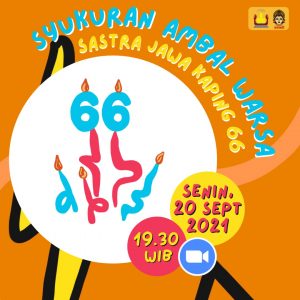
The 66th Javanese Literary Anniversary Celebration

Ambal WarsaCollege StudentNewsSDGSStudentStudent's ActivityStudent's Work Monday, 11 September 2023

Yogyakarta – The 66th anniversary of the Javanese Literature Study Program (Ambal Warsa) was commemorated by holding a joint celebration through the zoom meeting on September 20, 2021.

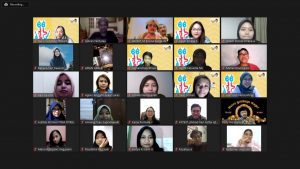
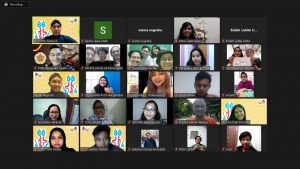
The celebration event was attended by the entire Javanese Literature family, both active and full-time lecturers, students, and alumnus from various generations. The event was carried out very well due to the enthusiasm of the participants which added to the excitement of commemorating the 66th anniversary of the Javanese Literature Study Program.

The event began with an opening by the master of ceremonies. Next is the speech given by the Head of the Javanese Literature Study Program. After that, active student representatives of the 2018, 2019, 2020, and 2021 batches gave impressions, messages, and hopes. Then, it was continued with reading the online bulletin magazine, intermezzo from Mr/Ms. Lecturer, as well as video presentation performances from Javanese Literature students. Then, it was closed with a prayer reading and a group photo, and closing by the master of ceremonies.

The following is a snapshot of the festive moment of the 66th Ambal Warsa Celebration :

Authors: Vighna Rivattyannur H. and Anggra Dini

Editor: Anggra Dini


Public Lecture “Problematic Grammar of Old Javanese” with Drs. Suharto Mangkusudarmo, M.Hum.

SDGSUncategorized Monday, 11 September 2023

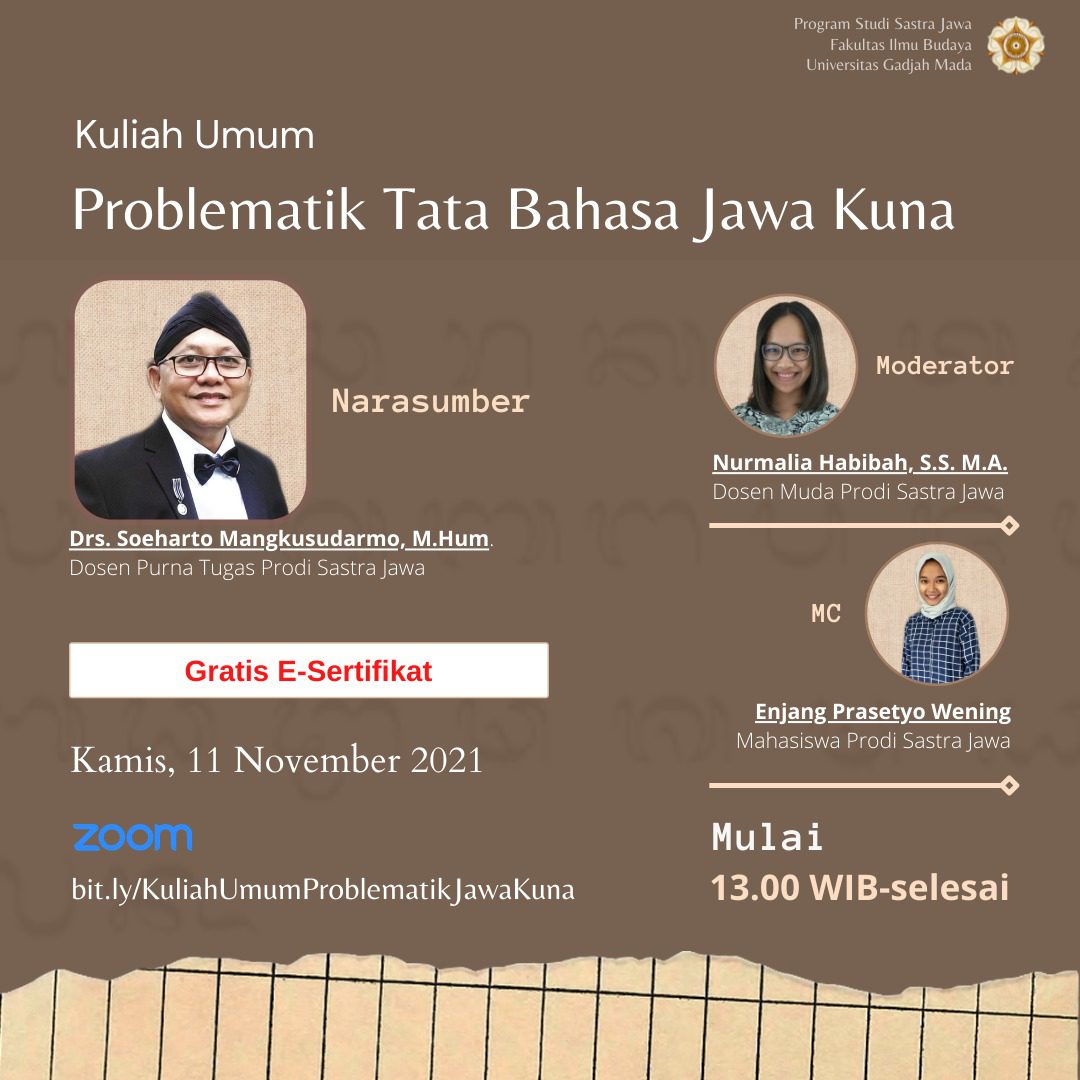
(Image: Public Lecture Poster)

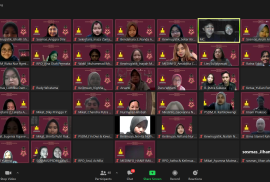
Yogyakarta – The Javanese Literature Study Program at Gadjah Mada University has conducted a public lecture entitled Old Javanese Grammatical Problems. In this public lecture, the Javanese Literature Study Program presented expert speakers, namely Drs. Suharto Mangkusudarmo, M.Hum., a retired lecturer in Javanese Literature at UGM. This activity is open to all UGM academicians and will be held on Thursday (11/11) through Zoom Meeting.

(Image: Zoom Meeting Footage)

This public lecture activity also presented one of UGM Javanese Literature lecturers with the same subject focus as the speaker (regarding Old Javanese), namely Nurmalia Habibah, S.S. M.A., as moderator. Complete with one Javanese Literature student, Enjang Prasetyo Wening, as Master of Ceremony (MC).

"The problematic Old Javanese grammar is Old Javanese grammar which still creates problems," said Drs. Suharto Mangkusudarmo, M.Hum.

Following the title raised, Drs. Suharto Mangkusudarmo, M.Hum., explained in detail the problems that arise in Old Javanese grammar. The problem with this Old Javanese grammar is that everyone's understanding is not always the same and tends to be different. The problem also lies in the syntax or sentence structure. Mastery of Old Javanese grammar will support anyone who studies and understands Old Javanese texts, especially parwa texts.

Comments and explanations regarding Old Javanese grammar were explained in a clear and detailed manner, supported by the material he had prepared. An example is regarding the phonology of Old Javanese. The different phonemic signs in the letters that explain the reading of Old Javanese also have different meanings. This is what makes Old Javanese a little difficult. He also said that reading accuracy in Old Javanese was necessary so that there would be no misperceptions of meaning.

After Drs. Suharto Mangkusudarmo, M.Hum., finished explaining everything and the session was opened by the moderator. The question and answer session lasted interactively until the end of the event. Public lectures are held for two full hours, from 01.00 pm to 03.00 pm WIB.

Meanwhile, Dr. Daru Winarti, M.Hum., as Chair of the Javanese Literature Study Program who was also present at this public lecture expressed his gratitude to the resource persons, moderators, MC, and colleagues who had attended, and hoped that anyone who attended the public lecture could gain useful knowledge and more insight, and be more interested in the field of Old Javanese, because this field requires experts and must be studied seriously due to its more difficult level. He also conveyed his hopes to Drs. Suharto Mangkusudarmo, M.Hum., so that he can assist in guiding Javanese Literature students, especially in understanding Old Javanese.

“Hope you guys find something useful. Hopefully, you will have more insight and then be more interested in this field," said Dr. Daru Winarti, M.Hum.

Author: Vighna R. Hernawan


Public Lecture “Modern Javanese Literature: From Padmasusastra to Suparto Brata” with Drs. Akhmad Nugroho, S.U.

NewsSDGS Monday, 11 September 2023

Yogyakarta – The Javanese Literature Study Program at Universitas Gadjah Mada has conducted public lectures with Drs. Akhmad Nugroho, S.U., a retired lecturer at the UGM Javanese Literature Study Program an expert speaker, this lecture discusses more deeply Modern Javanese Literature: From Padmasusastra to Suparto Brata. This activity is open to all UGM academicians and will be held on Tuesday (9/11) through Zoom Meeting.

In this public lecture, one of the Javanese Literature Study Program lecturers, Rudy Wiratama, S.IP., M.A. as the moderator and one of the 2019 Javanese Literature students, namely Eka Pradipta Kalingga Murda as Master of Ceremony (MC). read more

1…151617181920

Recent Post

  • Javanese Script Font Socialization Encourages Digital Javanese Script Use
    April 23, 2026
  • Seputar Jawa: The Digital Javanese Script Keyboard System
    April 13, 2026
  • First Gathering of the Sahacitta Cabinet of the Kamastawa Student Association: A Means of Introduction and Strengthening Togetherness
    April 6, 2026
  • Ghibran Arsha Daffa’ Musaffa’ Named Outstanding Student of the Year in 2026
    March 12, 2026
  • Seputar Jawa: Banten Javanese Dialect, a Dialect that Exists at the Westernmost of Javanese Island
    March 10, 2026

Calender

May 2026
M T W T F S S
 123
45678910
11121314151617
18192021222324
25262728293031
« Apr    
  • Fakultas Ilmu Budaya
  • Ujian Masuk UGM
  • PPSMB
  • Alumni
  • Jurnal Humaniora
May 2026
M T W T F S S
 123
45678910
11121314151617
18192021222324
25262728293031
« Apr    

News

  • Javanese Script Font Socialization Encourages Digital Javanese Script Use
    April 23, 2026
  • Seputar Jawa: The Digital Javanese Script Keyboard System
    April 13, 2026
  • First Gathering of the Sahacitta Cabinet of the Kamastawa Student Association: A Means of Introduction and Strengthening Togetherness
    April 6, 2026
Universitas Gadjah Mada

Javanese Language, Literature, and Culture Program
Department of Language and Literature
Faculty of Cultural Sciences
Universitas Gadjah Mada


Sosiohumaniora St., Bulaksumur, Yogyakarta
Telp : 0274-901134 Ext. 110, Fax : 0274-550451, WhatsApp : 081211911281
Email : nusantara@ugm.ac.id

© 2025 Javanese Language, Literature, and Culture Program FIB UGM

KEBIJAKAN PRIVASI/PRIVACY POLICY