• University
  • Academic Portal
  • University Library
  • Webmail
  • Arnawa
  • UM UGM
  • English
    • Bahasa Indonesia
    • English
Universitas Gadjah Mada Javanese Language, Literature, and Culture Program
Department of Language and Literature
Faculty of Cultural Sciences
Universitas Gadjah Mada
  • Home
  • Profile
    • Vision & Mission
    • Objective
    • Excellence
    • Career Prospects
    • Teaching Staff
  • Academic
    • Curriculum Flow
    • Courses Description
    • Distribution of Courses
    • Academic Calendar
    • COURSE AND ADMINISTRATION INFORMATION
    • Learning Outcomes
    • INTERNATIONAL CONFERENCES AND ACTIVITIES
  • KPPB
    • Collaboration
    • Research
      • Teaching Staff Research
      • Javanese Studies Archive – Arnawa
    • Service
      • Community Services
      • Podcast (Anarka Lālitya)
    • Scholarship
  • Student Affair
    • Student Satisfaction Survey
    • HMJ Kamastawa
    • Student’s Activity
    • Student’s Creations
    • Youtube Channel
    • Instagram
  • Alumnus
    • Alumnus Profile
  • Contact
  • Home
  • Ambal Warsa
  • Gugur Gunung 11 Webinar: History, Function, and Existence of Javanese Fables

Gugur Gunung 11 Webinar: History, Function, and Existence of Javanese Fables

  • Ambal Warsa, College Student, News, SDGS, Student
  • 14 September 2023, 17.07
  • Oleh: haryountoro
  • 0

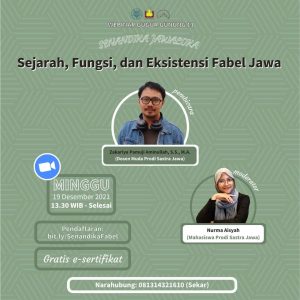
On Sunday (December 19, 2021), the Javanese Literature Program held the second webinar as a continuation of a series of events. The webinar titled "History, Function, and Existence of Javanese Fables" was moderated by Nurma Aisyah, a student of the Javanese Literature Program from class of 2021, and accompanied by one of the Javanese Literature lecturers, Zakariya Pamuji Aminullah, S.S., M.A., as the speaker.

The "History, Function, and Existence of Javanese Fables" webinar delved into the journey of birds and monkeys from the Sanskrit tradition to the Middle Javanese era. Mr. Zakariya presented that fables are stories about animals that behave like humans. The story of animals made like humans is a metaphorical depiction. Fables predominantly feature characters that are either human or deities. Usually, the animal characters used in fables play crucial roles in society, such as cows, horses, snakes, goats, birds, and others. The webinar also discussed the Pancatantra, a literary work that takes the form of framed stories.
After the presentation session, the webinar proceeded with a Q&A session. There were eight questioners, each with one question. One of the interesting questions, which might also be a common inquiry from the public, came from Irfan Wahyu, a Javanese Literature student. Irfan asked about the popularity of fables, specifically those involving the character "kancil" (mouse deer), and why fables are mainly targeted at children. Mr. Zakariya explained that Indonesian education has not adapted to fables effectively. Some efforts have been made by libraries to implement the transliteration of manuscripts, and academic communities are encouraged to disseminate these transliterations to the wider public. From the perspective of researchers, they face a significant responsibility in transforming the contents of manuscripts into works that can be accessible to the broader society.

The conclusion drawn from the "History, Function, and Existence of Javanese Fables" webinar is that fables serve as a medium between humans and animals. Meanwhile, the Pancatantra has political motives and has spread widely across the world. The popular story of birds and monkeys, despite having various versions, shares a common message.

Tags: FIB UGM Gugur Gunung JAVANESE FABLES javanese language literature and culture program JAVANESE LITERATURE SDGS 17: PARTNERSHIPS FOR THE GOALS SDGS 4: QUALITY EDUCATION WEBINAR

Leave A Comment Cancel reply

Your email address will not be published. Required fields are marked *

*

Recent Post

  • Seputar Jawa: Banten Javanese Dialect, a Dialect that Exists at the Westernmost of Javanese Island
    March 10, 2026
  • Seputar Jawa: Forms of Javanese Proverbs
    March 9, 2026
  • Graduating in 3.5 Years: The Strategy of Three Students from the Javanese Language, Literature, and Culture Study Program at UGM in Completing Their Studies
    March 2, 2026
  • Seputar Jawa: Basa Kedhaton and Basa Bagongan, Typical Speech Varieties of the Surakarta and Yogyakarta Palaces
    March 2, 2026
  • Three Students from the Javanese Language, Literature, and Culture Study Program Successfully Graduated in 3.5 Years
    February 26, 2026

Calender

April 2026
M T W T F S S
 12345
6789101112
13141516171819
20212223242526
27282930  
« Mar    
  • Fakultas Ilmu Budaya
  • Ujian Masuk UGM
  • PPSMB
  • Alumni
  • Jurnal Humaniora
April 2026
M T W T F S S
 12345
6789101112
13141516171819
20212223242526
27282930  
« Mar    

News

  • Seputar Jawa: Banten Javanese Dialect, a Dialect that Exists at the Westernmost of Javanese Island
    March 10, 2026
  • Seputar Jawa: Forms of Javanese Proverbs
    March 9, 2026
  • Graduating in 3.5 Years: The Strategy of Three Students from the Javanese Language, Literature, and Culture Study Program at UGM in Completing Their Studies
    March 2, 2026
Universitas Gadjah Mada

Javanese Language, Literature, and Culture Program
Department of Language and Literature
Faculty of Cultural Sciences
Universitas Gadjah Mada


Sosiohumaniora St., Bulaksumur, Yogyakarta
Telp : 0274-901134 Ext. 110, Fax : 0274-550451, WhatsApp : 081211911281
Email : nusantara@ugm.ac.id

© 2025 Javanese Language, Literature, and Culture Program FIB UGM

KEBIJAKAN PRIVASI/PRIVACY POLICY