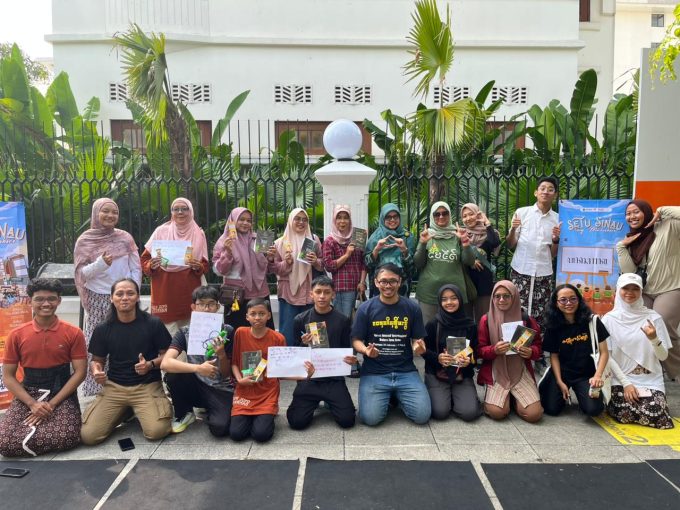
The Javanese Language, Literature, and Culture Study Program of the Faculty of Cultural Sciences at Universitas Gadjah Mada (FIB UGM), in collaboration with the Yogyakarta City Culture Office, organized an activity entitled Setu Sinau on Saturday (16/05/2026). The activity took place along the Malioboro corridor from 07.00–09.00 WIB as an effort to reintroduce Javanese script to the wider community, particularly the younger generation.
The selection of the Malioboro area as the location of the activity was not without reason. As one of the most iconic public spaces in Yogyakarta, Malioboro serves as a strategic place to present cultural learning directly within society. Its open and lively atmosphere enabled the activity to reach participants from various backgrounds, ranging from children to adults.
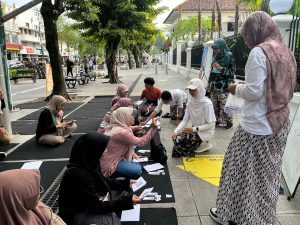
The implementation of Setu Sinau was motivated by the growing distance between the younger generation and Javanese script due to the currents of globalization and modernization. Through this activity, Javanese script was introduced not only as a cultural heritage, but also as part of an identity that needs to be preserved and passed on. The collaboration with the Yogyakarta City Culture Office became a tangible form of synergy between educational institutions and the government in supporting the implementation of the Yogyakarta Special Region Regulation related to the preservation of Javanese language, literature, and script.
The activity featured two lecturers from the Javanese Language, Literature, and Culture Study Program as instructors, namely Dr. Arsanti Wulandari, M.Hum. and Zakariya Pamuji Aminullah, S.S., M.A., who specialize in the field of philology. In addition, students from the Javanese Language, Literature, and Culture Study Program also served as facilitators, namely Ghibran Arsha Daffa’ Musaffa’, Bayu Seta Ardiansyah, Dian Patmisari, and Maysa Putri Fatihah.
The learning process was designed in an enjoyable and interactive manner. Participants were invited to learn Javanese script through media such as flashcards, educational posters, as well as direct practice in writing and pronouncing Javanese script. This approach enabled participants not only to understand the theory, but also to experience the learning process directly through simple practice.
The learning method applied was aligned with the value contained in pupuh Pocung stanza 33 by KGPAA Sri Mangkunegara IV, namely ngelmu iku kalakone kanthi laku, which means “knowledge is realized through action.” Through direct practice, participants were encouraged to understand that learning culture is not sufficient merely by knowing it, but also needs to be practiced and habituated in everyday life.
The implementation of Setu Sinau was also in line with the objectives of the Sustainable Development Goals (SDGs), particularly point 4 on quality education, point 11 on sustainable cities and communities, and point 17 regarding partnerships for achieving the goals. By presenting cultural learning in a public space, this activity became a small yet meaningful step in preserving the continuity of Javanese script amid the development of the times.
Author : Haryo Untoro
Editor : Haryo Untoro