• University
  • Academic Portal
  • University Library
  • Webmail
  • Arnawa
  • UM UGM
  • English
    • Bahasa Indonesia
    • English
Universitas Gadjah Mada Javanese Language, Literature, and Culture Program
Department of Language and Literature
Faculty of Cultural Sciences
Universitas Gadjah Mada
  • Home
  • Profile
    • Vision & Mission
    • Objective
    • Excellence
    • Career Prospects
    • Teaching Staff
  • Academic
    • Curriculum Flow
    • Distribution of Courses
    • Academic Calendar
    • Course and Administration Information
    • Learning Outcomes
    • INTERNATIONAL CONFERENCES AND ACTIVITIES
  • KPPB
    • Collaboration
    • Research
      • Teaching Staff Research
      • Javanese Studies Archive – Arnawa
    • Service
      • Community Services
      • Podcast (Anarka Lālitya)
    • Scholarship
  • Student Affair
    • Student Satisfaction Survey
    • HMJ Kamastawa
    • Student’s Activity
    • Student’s Creations
    • Youtube Channel
    • Instagram
  • Alumnus
    • Alumnus Profile
  • Contact
  • Home
  • News
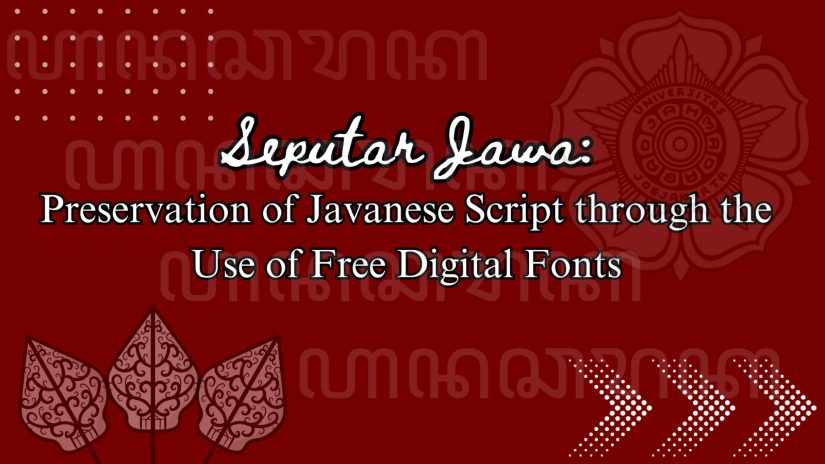
  • Seputar Jawa: Preservation of Javanese Script through the Use of Free Digital Fonts

Seputar Jawa: Preservation of Javanese Script through the Use of Free Digital Fonts

  • News, SDGS
  • 28 January 2026, 13.55
  • Oleh: haryountoro
  • 0

Javanese script is one of the traditional writing systems in Indonesia that is still known and used today. This script is classified as an abugida or syllabic script and is part of the Kawi script family (Maulana, 2020). Since ancient times, Javanese script has played an important role in documenting various knowledge, cultural values, and literary works recorded in Javanese manuscripts.

Technological developments and globalization have had a significant impact on patterns of communication within society. The increasingly dominant use of the Latin alphabet, particularly among the younger generation, has led to the Javanese script and other regional scripts being marginalized. The lack of use in everyday life has the potential to result in a decline in the ability to read and write Javanese script among future generations.

This situation calls for revitalization efforts that can adapt regional scripts to the changing times. This revitalization is an effort to introduce the script symbolically and encourage its active use today.

One form of Javanese script revitalization that is relevant to technological developments is through the provision of Javanese fonts. Fonts are digital representations of scripts that enable their use on various platforms, such as computers, devices, digital documents, and online media.

The existence of Javanese fonts facilitates the learning and teaching process, as the script can be written, read, and studied in a practical manner. In addition, Javanese fonts also open up opportunities for the use of script as an aesthetic element in graphic design and creative works.

To date, various Javanese fonts are available and accessible through various media. However, in order for their use to be sustainable, both for writing and aesthetic purposes, the use of license-free Javanese fonts is a more appropriate choice.

License-free fonts allow for widespread use without legal barriers or licensing fees. This greatly supports the use of Javanese script by educational institutions, cultural communities, designers, and the general public.

As a form of support for the preservation of Javanese script, in 2020 the Yogyakarta Special Region Cultural Office released a Javanese font developed by Apri Nugroho. There are two types of fonts introduced, namely nyk Ngayogyan and nyk Ngayogyan Jejeg. Both fonts can be downloaded via the following links:

  • Fon nyk Ngayogyan

https://aksaradinusantara.com/fonta/nyk-ngayogyan.font

  • Fon nyk Ngayogyan Jejeg

https://aksaradinusantara.com/fonta/nyk-ngayogyan-jejeg.font


In addition to providing fonts, the developers also provide installation guidelines, typing instructions, and keyboard layouts. These guidelines are intended to make it easier for users to install and use Javanese fonts correctly and consistently.

The use of Javanese script is also linked to Sustainable Development Goals (SDGs) 4 and 17. In the context of SDG 4 on quality education, the existence of Javanese script supports the provision of inclusive, contextual, and locally-based teaching materials, thereby facilitating the learning process and improving students' cultural literacy. Meanwhile, the achievement of these goals cannot be separated from SDG 17 on partnerships for the goals, because the development and utilization of Javanese phonetic script requires collaboration between the government, academics, technology developers, cultural communities, and the wider community.

Author           : Haryo Untoro

Editor             : Haryo Untoro

Bibliography

Maulana, R. (2020). Aksara-Aksara di Nusatara: Seri Ensiklopedia. Writing Tradition Project
Tags: DINAS KEBUDAYAAN DAERAH ISTIMEWA YOGYAKARTA FIB JAVANESE LANGUAGE javanese language literature and culture program JAVANESE LITERATURE SDGS SDGS 17: PARTNERSHIP FOR THE GOALS SDGS 17: PARTNERSHIPS FOR THE GOALS SDGS 4: QUALITY EDUCATION UGM

Leave A Comment Cancel reply

Your email address will not be published. Required fields are marked *

*

Recent Post

  • International Workshop Membaca Ulang Wayang: Mengenang yang Silam, Menjelang yang Datang (Rereading Wayang: Remembering the Past, Looking Toward the Future)
    July 10, 2026
  • Javanese Language, Literature, and Culture Study Program Lecturer Earns Doctoral Degree through a Study of the Middle Javanese Uttarakāṇḍa Manuscript
    July 8, 2026
  • Students from the Javanese Language, Literature, and Culture Program Served as Procession Attendant in the Dalem Mangkunegaran Heritage Procession on 1 Sura Be 1960
    June 17, 2026
  • A Space for Sharing and Reflection in the Meeting of YAD Scholarship Recipients, Even Semester of Academic Year 2025/2026
    June 1, 2026
  • “Pusaka Kata” Exhibition Highlights Nusantara Manuscript Treasures at Faculty of Cultural Sciences, Universitas Gadjah Mada
    May 27, 2026

Calender

July 2026
M T W T F S S
 12345
6789101112
13141516171819
20212223242526
2728293031  
« Jun    
  • Fakultas Ilmu Budaya
  • Ujian Masuk UGM
  • PPSMB
  • Alumni
  • Jurnal Humaniora
July 2026
M T W T F S S
 12345
6789101112
13141516171819
20212223242526
2728293031  
« Jun    

News

  • International Workshop Membaca Ulang Wayang: Mengenang yang Silam, Menjelang yang Datang (Rereading Wayang: Remembering the Past, Looking Toward the Future)
    July 10, 2026
  • Javanese Language, Literature, and Culture Study Program Lecturer Earns Doctoral Degree through a Study of the Middle Javanese Uttarakāṇḍa Manuscript
    July 8, 2026
  • Students from the Javanese Language, Literature, and Culture Program Served as Procession Attendant in the Dalem Mangkunegaran Heritage Procession on 1 Sura Be 1960
    June 17, 2026
Universitas Gadjah Mada

Javanese Language, Literature, and Culture Program
Department of Language and Literature
Faculty of Cultural Sciences
Universitas Gadjah Mada


Sosiohumaniora St., Bulaksumur, Yogyakarta
Telp : 0274-901134 Ext. 110, Fax : 0274-550451, WhatsApp : 08135932426
Email : nusantara@ugm.ac.id

© 2025 Javanese Language, Literature, and Culture Program FIB UGM

KEBIJAKAN PRIVASI/PRIVACY POLICY