Cultural preservation is not only carried out by maintaining the continuity of living traditions but also by reviving arts that are beginning to be abandoned. This effort is being undertaken by Ghibran Arsha Daffa’ Musaffa’, a 2024 student in the Javanese Language, Literature, and Culture Study Program, Faculty of Cultural Sciences, Universitas Gadjah Mada (FIB UGM). His interest in oral traditions, which began through his coursework, inspired Ghibran to take the initiative to revive the Gejog Lesung art tradition in Karang Tengah Hamlet, Bantul Regency, Special Region of Yogyakarta.
Gejog lesung is a traditional art form that uses the rhythmic sounds of a lesung as musical accompaniment. A lesung is a wooden vessel used to pound unhusked rice into rice grains. Over time, the pounding activity produced rhythmic sounds that were subsequently incorporated into artistic performances. In an online interview conducted on 22 September 2026, Ghibran explained that Gejog Lesung performances typically combine the rhythmic pounding of the lesung with traditional songs, such as Gugur Gunung and Prau Layar. In Karang Tengah Hamlet, this art form is represented by the Gejog Lesung Ngudi Lestari group.
According to Ghibran, the existence of the lesung is closely connected to the history of Karang Tengah Hamlet. A stone pounding tool known as watu lumpang was discovered in the area and is estimated to have existed since around 1632 CE. The tradition of pounding has also been practised for a long time, one aspect of which is associated with the role of the Karang Tengah community in providing food supplies for the abdi dalem who built the tomb complex of the Mataram kings in Imogiri. At that time, pounding was carried out to process unhusked rice into rice grains. Over time, stone pounding tools were replaced by wooden lesung, which were considered more flexible to use. The activity of pounding with a lesung produced interesting, rhythmic sounds. These sounds not only accompanied the work but could also boost people's enthusiasm while working and serve as entertaining spectacles. From this practice, Gejog Lesung developed into a form of cultural expression within the local community.
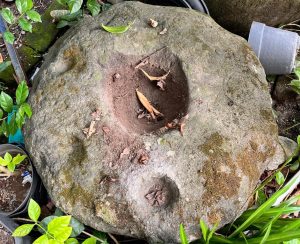
Documentation of Watu Lumpang
The Gejog Lesung Ngudi Lestari group was established in 1965, with performances involving people pounding the lesung and singers performing traditional songs. Later, in 2000, the group began incorporating dancers to visually interpret the songs being performed. For example, when performing Gugur Gunung, the dancers portray activities associated with gotong royong (mutual cooperation). The combination of the sounds of the lesung, singing, and dancing made the performances more diverse.
Throughout its history, Gejog Lesung Ngudi Lestari has frequently performed at various community events, ranging from village anniversary celebrations and community gatherings to cultural events. The group was also once invited to perform at Kanjengan, Imogiri, as part of the Kirab Siwur tradition, a procession in which a siwur is carried as part of the nguras enceh ritual series. The ritual involves cleaning the water vessels and filling them with water at the tomb complex of the Islamic Mataram kings in Imogiri.
However, over time, this artistic activity entered a state of “suspended animation” due to the absence of generational succession. This situation encouraged Ghibran to take part in efforts to preserve the art form in his area. His interest grew further when he took the Oral Tradition course in the Javanese Language, Literature, and Culture Study Program at FIB UGM. The course marked one of the starting points for Ghibran to gain a deeper understanding of the gejog lesung tradition while encouraging him to engage directly in its preservation. “Thanks to the Oral Tradition course, I was encouraged to learn more about this tradition, and it also strengthened my motivation to bring it back,” Ghibran explained.
In addition to being a university student, Ghibran is active in the youth organization Angkatan Muda-Mudi Islam (AMMI) Karang Tengah, particularly in its literacy and education division. Through his involvement in the organization, he initiated the formation of Gejog Lesung Ngudi Lestari New Generation as an effort to continue the artistic tradition that had previously ceased. This initiative involved local young people while also inviting the elders to share their knowledge and skills related to the gejog lesung art form. “We started from scratch and also invited the elders to teach us. They were happy because this art form now has successors,” he added.
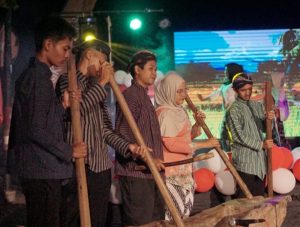
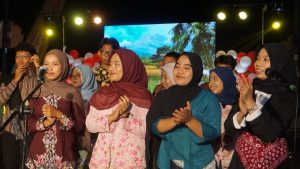
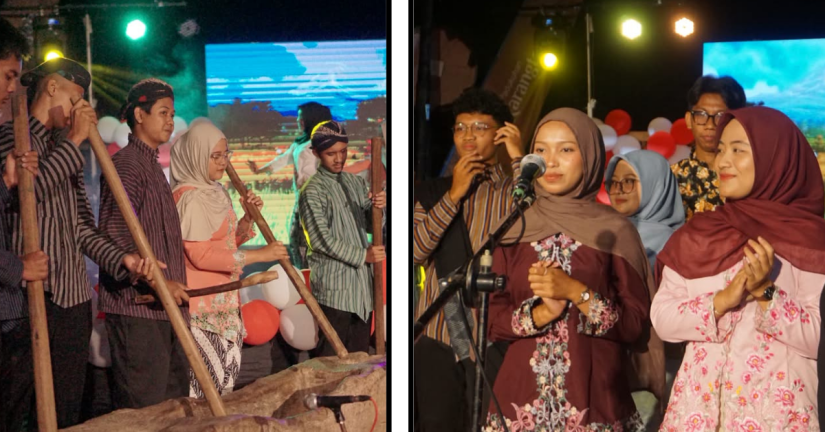
Gejog Lesung Ngudi Lestari New Generation Performance
Rebuilding the artistic group was not without challenges. In the early stages, Ghibran faced difficulties in encouraging young people to get involved. Nevertheless, the gradual approach he adopted began to foster enthusiasm among the members. “At first, it was somewhat difficult, though manageable. Some felt inferior, while others were embarrassed to take part in preserving this tradition. However, Alhamdulillah, with strong efforts, my friends became enthusiastic and even expressed plans to hold regular weekly practice sessions,” Ghibran explained.
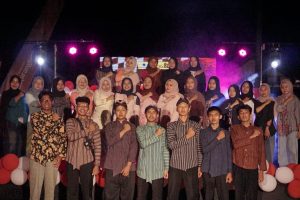
Gradually, these efforts began to bear fruit. Gejog Lesung Ngudi Lestari New Generation performed again, combining the rhythmic pounding of the lesung, singing, dancing, and ketoprak performances during the celebration of the Independence Day of the Republic of Indonesia on 17 August. The performance served as a step towards reintroducing gejog lesung to the community while fostering greater interest among young people in local arts. This effort also attracted the attention of the Bantul Regency Cultural Office and the Deputy Regent of Bantul. Going forward, the art form is planned to be featured in various cultural programmes or events.
Ghibran’s initiative demonstrates that cultural preservation can begin within one's immediate surroundings and develop through the active involvement of young people. Through the knowledge gained at university, support from youth organizations, and the involvement of elders in passing down traditional knowledge, a tradition that had previously ceased can once again find room to develop. The efforts of nguri-uri ‘preserving’ and ngurip-urip ‘reviving’ culture demonstrate that cultural preservation is not merely about safeguarding identity; it also creates opportunities for culture to bring benefits to the community itself.
Author : Haryo Untoro
Editor : Haryo Untoro