• University
  • Academic Portal
  • University Library
  • Webmail
  • Arnawa
  • UM UGM
  • English
    • Bahasa Indonesia
    • English
Universitas Gadjah Mada Javanese Language, Literature, and Culture Program
Department of Language and Literature
Faculty of Cultural Sciences
Universitas Gadjah Mada
  • Home
  • Profile
    • Vision & Mission
    • Objective
    • Excellence
    • Career Prospects
    • Teaching Staff
  • Academic
    • Curriculum Flow
    • Distribution of Courses
    • Academic Calendar
    • Course and Administration Information
    • Learning Outcomes
    • INTERNATIONAL CONFERENCES AND ACTIVITIES
  • KPPB
    • Collaboration
    • Research
      • Teaching Staff Research
      • Javanese Studies Archive – Arnawa
    • Service
      • Community Services
      • Podcast (Anarka Lālitya)
    • Scholarship
  • Student Affair
    • Student Satisfaction Survey
    • HMJ Kamastawa
    • Student’s Activity
    • Student’s Creations
    • Youtube Channel
    • Instagram
  • Alumnus
    • Alumnus Profile
  • Contact
  • Home
  • 2026
  • August
Arsip 2026:

August

UGM Female Student of Javanese Language, Literature, and Culture Documents Temanggung Language and Javanese Script through KKN-PPM in Bansari Village

College StudentNewsSDGSStudentStudent's ActivityStudent's Work Wednesday, 19 August 2026

Eka Nur Cahyani, a student of the Javanese Language, Literature, and Culture (BSBJ) Study Program at the Faculty of Cultural Sciences (FIB), Universitas Gadjah Mada (UGM), implemented a regional language and script preservation program during the UGM Community Empowerment Student Study Service (KKN-PPM) for the second period of 2026. Eka, a 2023 cohort student, was part of the KKN unit "Waksudha Bansari 2026" (code JT123), which carried out service in Bansari Village, Temanggung Regency, from June 20 to August 8, 2026.

During her time in Bansari Village, Eka conducted two programs related to her field of study: Nyinau Basa Temanggungan (Learning Temanggung Language) and Ayo Sinau Aksara Jawa (Let’s Learn Javanese Script). The first program focused on documenting the Temanggung language (Bansari dialect), while the second was aimed at introducing Javanese script to students at SDN (Public Elementary School) Bansari, specifically in Pringapus hamlet, Bansari Village.

Through the Nyinau Basa Temanggungan program, Eka compiled a pocket dictionary of the Temanggung language (Bansari dialect). Vocabulary data was collected through interviews with village officials and community members who are native speakers, utilizing the Swadesh 200-word list. The Swadesh 200-word list is a basic vocabulary list compiled by linguist Morris Swadesh in 1952. This list contains approximately 200 universal concepts believed to be possessed by nearly all languages; they are relatively stable, rarely borrowed, and tend to persist over long periods (Swadesh, 1952). The data was then analyzed and organized into entries for a pocketbook, complete with word categories and Indonesian equivalents. Uniquely, the compilation of this dictionary also served as an application of knowledge acquired from her Lexicography and Interdisciplinary Linguistics courses. The pocketbook is expected to document the Bansari dialect of the Temanggung language still used by the community while acting as a medium to introduce local language and culture to support the development of Bansari Village as a tourist destination.

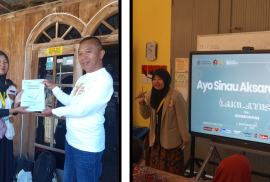
Furthermore, the second program, Ayo Sinau Aksara Jawa, was carried out in collaboration with students at SDN Bansari. The activity began with coordination with teachers to determine the state of Javanese script instruction at the school. Subsequently, material was delivered through flashcards, educational games, reading and writing practice, and an introduction to the rules of Javanese script writing.

Enthusiasm of SDN Bansari Students in Participating in the Ayo Nyinau Aksara Jawa Program

In addition to reading and writing, Eka also introduced the iluminasi rerenggan (illuminated ornamentation) found in Javanese manuscripts to the students. Illumination refers to the brightening or heightening of a manuscript page's impression through writing techniques, color patterns, decorative framing of text, rubrics, and calligraphy (Behrend, 1996), including wedana, rerenggan, and stanza markers (Saktimulya, 2015). After being introduced to rerenggan as manuscript decoration, the students were invited to decorate their names written in Javanese script. Through this activity, the students not only practiced writing the script but also became familiar with elements of art and aesthetics in the Javanese manuscript tradition.

In its implementation, both programs naturally faced a number of challenges. In the Nyinau Basa Temanggungan program, for example, differences in vocabulary usage were found between generations. This condition required Eka to verify data with multiple sources to ensure accuracy. Meanwhile, in the Ayo Sinau Aksara Jawa program, challenges arose from the diverse abilities of the students and the perception that Javanese script is a difficult subject to learn.

Nevertheless, both programs received a positive response from the community and the school. In compiling the dictionary, the community and village officials provided information on vocabulary still used in daily conversation. At school, students participated in the Javanese script program with enthusiasm, both through games and script-writing practice. According to Eka, the use of interactive learning media is one way to increase students' interest and ability in reading and writing Javanese script.


The KKN-PPM implementation produced two main outputs. The Nyinau Basa Temanggungan program resulted in a printed and digital pocket dictionary of the Temanggung language (Bansari dialect), which can be accessed via the following link: Google Drive Link.

Meanwhile, the Ayo Sinau Aksara Jawa program produced a number of student works in the form of rerenggan illuminations on Javanese script writing. Both outputs are part of an effort to document local language while introducing Javanese script and traditional arts to the younger generation.

Some examples of work by SDN Bansari students

KKN-PPM programs like the one conducted by Eka serve as a tangible form of introducing, preserving, and "grounding" the wealth of regional culture, specifically Javanese language and culture, through direct involvement in the community. By compiling the pocket dictionary and providing Javanese script instruction to elementary students, the knowledge gained during her studies was applied while providing benefits to the community. These activities also align with the Sustainable Development Goals (SDGs): Point 4 on quality education and Point 17 on partnerships for the goals, through collaboration between students, the community, village government, and schools.


Author            : Eka Nur Cahyani & Haryo Untoro
Editor             : Haryo Untoro


References

Behrend, T. E. (1996). Textual Gateways: The Javanese Manuscript Tradition. Dalam A. Kumar & J. H. McGlynn (Eds.), Illuminations: The Writing Traditions of Indonesia: Featuring Manuscripts from the National Library of Indonesia (pp. 161–200). The Lontar Foundation; New York & Tokyo: Weatherhill, Inc. https://books.google.com/books?id=-n5iAAAAMAAJ 

Swadesh, M. (1952). Lexico-statistic dating of prehistoric ethnic contacts. Proceedings of the American Philosophical Society, 96(4), 452–463.

Saktimulya, S. R. (2015). Naskah-Naskah Skriptorium Pakualaman Periode Paku Alam II (1830–1858): Kajian Kodikologi, Filologi, dan Hermeneutika. École française d'Extrême-Orient.


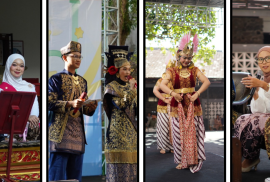
Contributions of Students and Alumni of the Javanese Language, Literature, and Culture Study Program to Pionir Kampung Budaya 2026

AlumnusCollege StudentNewsSDGSStudentStudent's Activity Friday, 7 August 2026

Questions such as “Nek kuliah neng Sastra Jawa ’ki arep dadi dukun ’pa?” (If you study Javanese Literature, do you want to become a traditional healer?) may still be encountered as a common perception of the field of Javanese language, literature, and culture. In reality, opportunities for students to develop themselves in these fields can take many forms, including performing arts, event hosting, and cultural activities.

This was among the things reflected in the implementation of Pionir Kampung Budaya 2026. A number of students from the Javanese Language, Literature, and Culture Study Program were involved in the series of activities in various roles. Their involvement extended beyond academic activities, encompassing participation in student activity units as well as experience in the arts and event hosting.

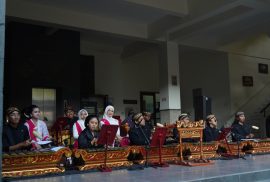
One of the groups involved was Gamelan Sastra Nusantara (Gamasutra), a student activity unit under the Student Association of the Javanese Language, Literature, and Culture Study Program (HMJ Kamastawa). Gamasutra performed gamelan music during the morning activities while welcoming the new students, or Mahadaya, of the 2026 cohort. The group also accompanied the opening series of events through the inauguration of Pionir Kampung Budaya 2026.

In addition to Gamasutra, Ratnaraya, a student organization dedicated to traditional dance, also took part in the event. Students from Ratnaraya performed Tari Golek Ayun-Ayun Jugag, a traditional dance from Yogyakarta that portrays a young woman entering adulthood and searching for her identity. The involvement of both student organizations highlights the activities of students in the Javanese Language, Literature, and Culture Study Program in the fields of art and culture.

Student involvement was also evident in event hosting. Two students from the Javanese Language, Literature, and Culture Study Program, Ghibran Arsha Daffa’ Musaffa’ and Ananda Choirul Nur Alalia, served as master of ceremonies (MCs) during Pionir Kampung Budaya 2026. Ghibran is a member of the 2024 cohort, while Ananda is from the 2025 cohort. Both have previous experience as event hosts on various occasions.

The event also involved alumni of the Javanese Language, Literature, and Culture Study Program. Nurma Aisyah, S.S., an alumna of the study program who currently works as an event host and journalist at Tribunnews, participated as one of the speakers. Her involvement represents another example of how graduates of the Javanese Language, Literature, and Culture Study Program have pursued professional careers related to communication and media.

These various roles demonstrate that students from the Javanese Language, Literature, and Culture Study Program can contribute to campus activities through a wide range of fields. Knowledge of language, literature, and culture can go hand in hand with the development of other skills, such as performing arts, public communication, leadership, and event hosting.

Participation in activities such as Pionir Kampung Budaya 2026 can also provide students with opportunities to gain experience beyond the classroom. Such experiences can become part of their learning process while helping them develop skills needed in both academic life and the professional world.


In this regard, Mahadaya are encouraged to continue learning and developing themselves through both academic studies and various activities on and off campus. These experiences can serve as valuable foundations for developing their knowledge, skills, and abilities in accordance with their areas of interest.


Author            : Haryo Untoro
Editor             : Haryo Untoro

Gamasutra Enlivens Pionir Kampung Budaya 2026

College StudentNewsSDGSStudentStudent's ActivityStudent's Work Thursday, 6 August 2026

The Faculty of Cultural Sciences (FIB), Universitas Gadjah Mada (UGM), held Pionir Kampung Budaya on Wednesday–Thursday, 5–6 August 2026, as part of the Pionir Gadjah Mada series. The event served as an introduction to the faculty environment for the 2026 cohort of new students, known as Mahadaya, while also introducing them to various academic and student activities available during their studies at FIB UGM.

One of the activities featured during the opening of Pionir Kampung Budaya 2026 was a performance by Gamelan Sastra Nusantara (Gamasutra). Several students from the Department of Javanese Language, Literature, and Culture who are members of Gamasutra participated in the event through a traditional Javanese gamelan performance. Gamasutra is a student organization that provides a space for students interested in Javanese gamelan music to learn, practice, and develop their skills in the traditional performing art.

Gamasutra's gamelan performance accompanied the opening of Pionir Kampung Budaya 2026 and welcomed the new Mahadaya students. The performance also accompanied the arrival of the Chair of Pionir Kampung Budaya 2026, the 2026 President of the Student Executive Board (LEM), the Dean of FIB UGM and faculty leadership, as well as heads of departments across FIB UGM. Gamasutra's presence formed part of the event's activities introducing new students to faculty life through artistic and cultural experiences.

Gamasutra's performance continued during the official inauguration of Pionir Kampung Budaya 2026. The students' involvement in the ceremony demonstrated that the new student orientation program extends beyond introducing the academic environment, while also providing opportunities for students to take part directly in artistic and cultural activities within the faculty.

For Gamasutra, participation in Pionir Kampung Budaya provided an opportunity for its members to put their gamelan skills into practice while introducing the art of gamelan to the new students. For the 2026 Mahadaya cohort, the performance became part of their initial experience of student life at FIB UGM, including an introduction to various opportunities for developing their interests and participating in artistic activities during their studies.

The event also forms part of FIB UGM's efforts to provide students with opportunities to develop their interests, skills, and experience in the arts. As an academic environment dedicated to the study of language, literature, and culture, FIB UGM recognizes artistic and cultural activities as an important complement to students' educational experiences beyond the classroom. This effort is aligned with the Sustainable Development Goals (SDGs), particularly SDG 4 (Quality Education) through the development of students' experiences and potential, and SDG 17 (Partnerships for the Goals) through collaboration in organizing activities within the faculty.

Through Pionir Kampung Budaya 2026, Gamasutra's participation brought together the introduction of new students to university life with artistic practice carried out by FIB UGM students. For the 2026 Mahadaya cohort, the experience marked part of their first steps in becoming familiar with the faculty environment, including opportunities to learn, create, and participate in student life at FIB UGM.


Author            : Haryo Untoro
Editor             : Haryo Untoro

Recent Post

  • Javanese Language, Literature, dan Culture Program Fast Track Student Participates in International Linguistics Conference
    September 14, 2026
  • HMJ Kamastawa Academic Affairs Division Holds KRS and Course Registration Orientation for 2026 Mahadaya
    September 11, 2026
  • Getting to Know the Javanese Language, Literature, and Culture Study Program through the Study Program Introduction Session at Pionir Kampung Budaya 2026
    September 7, 2026
  • Javanese Language, Literature, and Culture Program UGM Launches Community Engagement Program with First Meeting at SMA Negeri 1 Depok
    September 4, 2026
  • UGM Female Student of Javanese Language, Literature, and Culture Documents Temanggung Language and Javanese Script through KKN-PPM in Bansari Village
    August 19, 2026

Calender

August 2026
M T W T F S S
 12
3456789
10111213141516
17181920212223
24252627282930
31  
« Jul   Sep »
  • Fakultas Ilmu Budaya
  • Ujian Masuk UGM
  • PPSMB
  • Alumni
  • Jurnal Humaniora
August 2026
M T W T F S S
 12
3456789
10111213141516
17181920212223
24252627282930
31  
« Jul   Sep »

News

  • Javanese Language, Literature, dan Culture Program Fast Track Student Participates in International Linguistics Conference
    September 14, 2026
  • HMJ Kamastawa Academic Affairs Division Holds KRS and Course Registration Orientation for 2026 Mahadaya
    September 11, 2026
  • Getting to Know the Javanese Language, Literature, and Culture Study Program through the Study Program Introduction Session at Pionir Kampung Budaya 2026
    September 7, 2026
Universitas Gadjah Mada

Javanese Language, Literature, and Culture Program
Department of Language and Literature
Faculty of Cultural Sciences
Universitas Gadjah Mada


Sosiohumaniora St., Bulaksumur, Yogyakarta
Telp : 0274-901134 Ext. 110, Fax : 0274-550451, WhatsApp : 08135932426
Email : nusantara@ugm.ac.id

© 2025 Javanese Language, Literature, and Culture Program FIB UGM

KEBIJAKAN PRIVASI/PRIVACY POLICY